Best DAW for Chromebook: Free, No Install, AI Producer
The best DAW for Chromebook is free in Chrome: Veena's CoProducer builds songs as real tracks you can edit, record over, mix and export. No install needed.
The best DAW for Chromebook is Veena, a free AI DAW with a personal music producer built in. It opens in Chrome at daw.veena.studio with nothing to install: describe a song and CoProducer builds it with you as real tracks, drums, bass, chords and melody, that you can edit, record over, mix and export.
A Chromebook runs web apps, Android apps and, if you switch it on, a Linux environment. It does not run Windows or macOS software, and that rules out the DAWs most tutorials assume: FL Studio, Ableton Live, Logic Pro, Pro Tools and Cubase list no ChromeOS version on their makers' own pages (checked September 2026). So a Chrome DAW is not the compromise on ChromeOS. It is the studio. The only question is which one gives you the most song, and what it charges for it.
The best DAW for Chromebook, ranked (September 2026)
How we picked: these are the tools people reach for on a Chromebook, in Chrome, as an Android app or through ChromeOS's Linux environment. We ranked them on what a producer needs to get from a 16-bar idea to a finished WAV: who writes the parts, how many tracks and minutes you get, whether you can split a recording into stems, and what the free plan lets you export. Every rival fact comes from the maker's own pricing, help or download page, read on 23 September 2026.
1. Veena: a free studio in Chrome, with a producer who builds the song with you
Open daw.veena.studio in Chrome, sign in with Google, and the whole studio is there: a multitrack timeline, a piano roll with a velocity editor, the Beat Maker step sequencer for drums, a 16-pad sampler, a mixer with per-track faders and pan, and 10 built-in effects. The sounds come with it: 61 instrument presets, 39 of them on Veena's own synth including six 808s, and 7 drum kits from TR909 to Brush. Nothing downloads to your Chromebook's drive before you play a note.
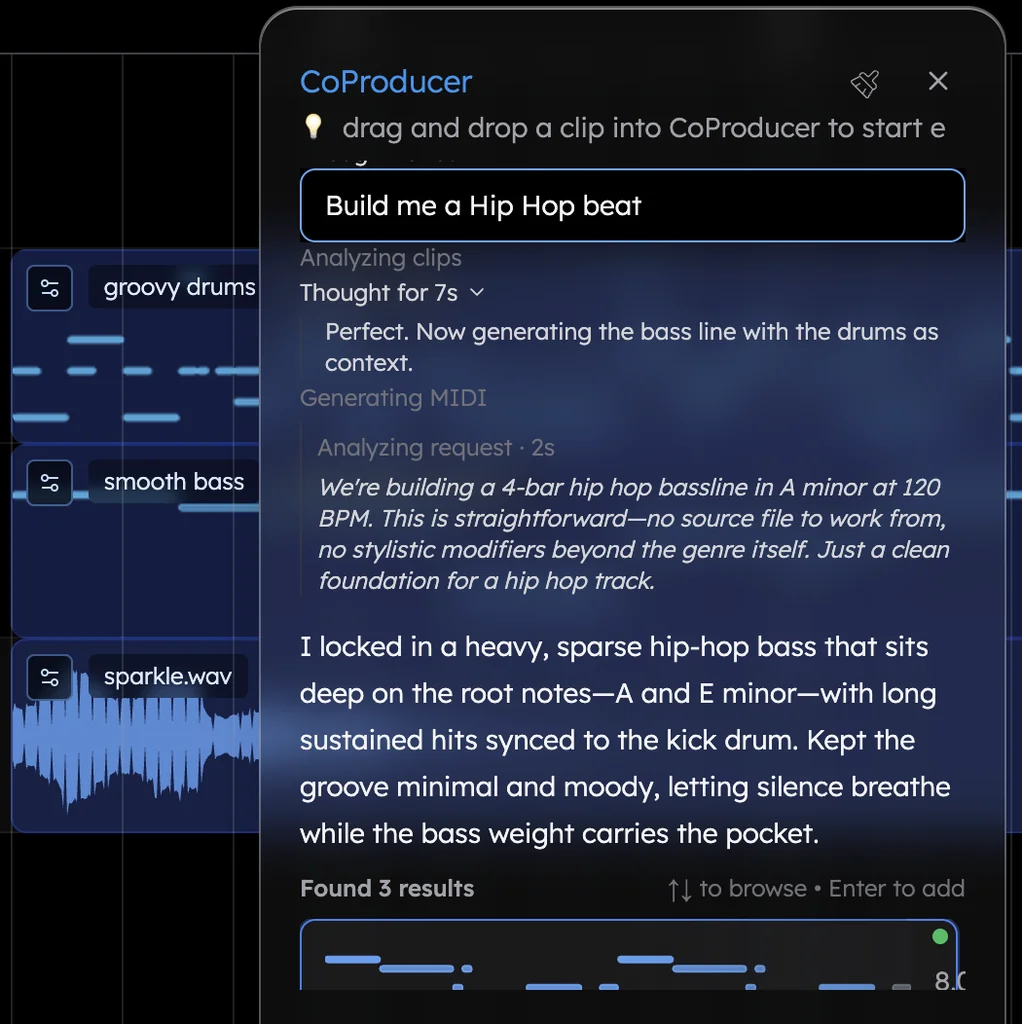
The difference is CoProducer, your personal music producer. Type the song you hear, say "a 90 BPM boom bap beat in D minor with Pop kit drums, Electric Piano chords and a Round Bass line", and it plans the sections, sets the tempo and key, and writes each part as a real track. For every new part it offers 3 options. You audition them in the mix and pick one, and a part that has to fit another waits for it and reads the notes you actually kept, so the bass locks to the kick you chose. Then keep producing in plain words: "make the drums half-time", "swap the piano for a Glass Pad", "add a bridge after the second chorus". One undo reverses any change CoProducer makes.
Name the genre when you ask. In Veena's own data, 3 in 4 new users (75.7%) whose first request asks for a new song get a finished first result on day one, and 81.5% do when the request names a genre.
Your Chromebook only has to play the session. CoProducer's models, stem separation and re-voicing run on Veena's servers, so there is no graphics card to worry about and no sound library to install. Record with the built-in microphone or a USB mic, and play parts on a USB MIDI keyboard through Chrome's Web MIDI.
Bring your own audio too: voice memos, demos, loops and old bounces in 13 audio formats, plus MIDI and video files. Drop a loop and CoProducer measures its tempo and builds on it. Hum a melody and it comes back as a saxophone or a synth pad. Split any recording into 4 stems, vocals, drums, bass and other, lined up on your timeline next to the original.
When the song is done, export a 24-bit/48 kHz WAV, a 320 kbps MP3, the MIDI, or every track as stems in a zip, as often as you like, with no watermark on your exports. You own your music: Veena's terms say "you own the Output you generate through your use of the Service." Projects save to your account while you work, so the song opens on any computer where you sign in, and since 12 September 2026 you can invite a friend into the session and build it together in real time.
What it costs: a free plan with a daily CoProducer allowance and the rest of the studio included. Veena Pro, $20 a month, removes the daily request cap and unlocks the premium models.
2. BandLab: free in Chrome, until a song passes 16 tracks or 15 minutes
BandLab's web Studio runs on "a computer that can run the latest version of Chrome, Firefox, or any Chromium-based browser" and costs nothing to start. The ceiling is in its own help centre: "You can create up to 16 tracks with a maximum duration of 15 minutes" (BandLab help centre, September 2026). A Membership raises that to 32 tracks, and every plan keeps the 15-minute limit.
Its AI tools, Voice Cleaner and AutoMix, are Membership features at $14.99 a month, or $99 for the first year and $149 a year after. Of the ideas its SongStarter generates, BandLab says "you won't own the rights to the generated track". SongStarter hands you an idea; the rest of the song is yours to write.
3. Soundtrap: on the Chromebook support list, with WAV and stems behind a paywall
Soundtrap's browser support table lists Chromebook, with the note "Recording may have higher latency" (Soundtrap support, September 2026). Its free plan is built around loops, but "WAV downloads (or high quality downloads) are only available on Music Production, Production & Vocals, and Vocals & songwriting", which cost US$16.99 to US$20.99 a month. The Stem Splitter needs the top plan, Production & Vocals, and Soundtrap says "some loops and instruments are locked unless you're on a paid subscription plan". Nothing on its plan pages is labelled AI, so every part is yours to place by hand.
4. Audiotool: free and uncapped, with every cable yours to patch
Audiotool calls itself "a 100% free, browser-based DAW with no track or feature caps" and says "it works on Chromebooks" (Audiotool, September 2026). What it doesn't have is a producer. No built-in generative AI appears on its product pages; its AI arrives through Nexus, an open API for other companies' apps. You "patch devices together with node- and cable-based routing", in Audiotool's words, and the wiring and every note are yours to build. Its plug-in support needs the VST Bridge companion app, which Audiotool offers for Windows, macOS and Linux, and Safari is "currently out of scope".
5. Amped Studio: a free plan that can't export the project
Amped Studio "only works with Chromium based browsers like Chrome, Edge, Opera and Brave" (Amped Studio FAQ, September 2026). Its free Starter plan lists ads, 5 projects, 16 tracks, "No projects export", "Export only in MP3 format" and "0GB storage for external audio files", so a vocal you recorded elsewhere has nowhere to go. The AI Assistant sits on the Premium + AI plan at $12.99 a month, and Amped says its arrangements are "audio stems from a sound library database".
6. FL Studio Mobile: the Android app, not FL Studio
FL Studio, the $99-to-$449 DAW, installs on Windows and macOS (Image-Line pricing and download pages, September 2026). Image-Line's Chromebook option is a different product: FL Studio Mobile, which it lists as "Available on Android and Chromebook", with "8 instruments, 1000+ sounds and 30+ effects". It is a mobile sketchpad with a fixed sound set, and nobody in it writes the next part with you.
7. Suno Studio: a browser DAW that starts at $30 a month
Suno Studio runs in Chrome on a laptop and is included only in Suno's Premier plan, $30 a month or $24 a month billed yearly (Suno pricing page, September 2026). Suno's help centre says "Suno Studio is not compatible with VST or Audio Units plugins", and Suno's free plan carries "No monthly song downloads" and "No commercial rights". Veena's studio, producer included, is free.
8. REAPER or LMMS in ChromeOS's Linux environment
Switch on Linux and a Chromebook can install Linux builds of desktop DAWs. REAPER "supports Linux on Intel and ARM architectures" and costs $60 or $225 after a 60-day evaluation; LMMS is free, but its latest stable release, 1.2.2, dates from June 2020 (REAPER and LMMS download pages, September 2026). Neither offers a ChromeOS version. Both mean installing software and setting up audio on a laptop built to avoid exactly that, and neither brings a producer.
Veena vs the other DAWs for Chromebook (September 2026)
| Veena | BandLab | Soundtrap | Amped Studio | Suno Studio | |
|---|---|---|---|---|---|
| Price of the studio | Free | Free; Membership $14.99/mo | Free; WAV plans US$16.99–20.99/mo | Free; AI plan $12.99/mo | $30/mo (Premier plan only) |
| Who writes the parts | CoProducer, with you, from one sentence | You; SongStarter ideas you don't own | You | You; the AI plan assembles library stems | Studio Chat, on Premier |
| Split a recording into stems | 4 stems on every plan | 3 splits a day free | Top plan only | AI plan only | Paid plans only |
| Free-plan export | 24-bit WAV, MP3, MIDI, stems; no cap, no watermark | M4A or 16-bit WAV mixdown | No WAV downloads | MP3 only; "No projects export" | No Studio; "No monthly song downloads" |
Your first song on a Chromebook, step by step
- Open Chrome and go to daw.veena.studio. Sign in with your Google account.
- If Veena opens its phone studio, maximise Chrome: the full studio opens in a window at least 1,000 pixels wide.
- Click New Project. A blank project opens with 6 tracks.
- Paste the prompt from the end of this page into CoProducer and press Enter. It sets 90 BPM and D minor, plans the 16 bars and offers 3 options for each part as it writes it. Browse them with the arrow keys and press Enter on the one you like.
- Pick the rest of the parts the same way. Then play it back with the space bar and ask for changes in your own words, like "make the hats swing harder" or "drop the bass out for bars 5 to 8".
- Record a vocal or a guitar over it: click record in the transport bar, allow the microphone when Chrome asks, and run Calibrate once so your takes land on the beat.
- Open the account menu in the sidebar, choose Export, and take a 24-bit WAV of the mix or every track as stems.
On a slower Chromebook, if playback crackles in a busy session, open Studio Settings, then Audio Settings, and raise Audio Buffer Size from 512 to 1024 samples. The Veena on Chromebook and Linux help page covers microphones, MIDI keyboards and screen size in detail.
What a Chromebook actually needs from a DAW
No install, and a light footprint. A Chromebook keeps little on its own drive and runs its apps from the web. Veena uploads your imports to your cloud storage and saves your projects to your account, so a small drive holds the same catalogue as a studio desktop.
Help writing the parts. A Chromebook is often the first computer someone makes music on, and a blank timeline is where most first songs stop. In Veena you start from one sentence, and CoProducer's first draft is a set of real tracks you can learn from, change and record over.
A way in for your own recordings. About 1 in 4 first requests in Veena's own data refer to the user's own audio: a recording, demo, loop or voice memo. Import it, split it with the stem splitter, or let CoProducer build a song around it.
Everything the same on the next computer. Sign in on a school Chromebook, a family laptop or a new Googlebook and your projects are there, because they live in your account rather than on the machine.
Googlebook, school Chromebooks and Linux
Google's new Googlebook laptops are "built on the Android technology stack and paired with desktop foundations from ChromeOS", ship with "the desktop-class Chrome browser with extensions", and arrive on US shelves on 4 October 2026 (Google, September 2026). Veena runs in the browser, so the studio in this guide is the one you open there: see Googlebook music production. Buying for a class? Our guide to the best DAW for school computers covers managed Chromebooks and sign-in, and the best DAW for Linux covers the other laptop that can't install Windows software. For the studio itself, feature by feature, see the online DAW.
The verdict: Veena is the best DAW for Chromebook
Every other studio on this list makes you pay somewhere: in tracks, in minutes, in export quality, in a $30 plan, or in every part written by hand. Veena gives a Chromebook the full studio free, in Chrome, with a producer who builds the song with you and exports you own. Open daw.veena.studio, sign in with Google, and paste the prompt below.
Related reading: Googlebook music production · best DAW for Linux · best DAW for school computers · best DAW for a low-end PC
Try this in Veena
Make a 90 BPM boom bap beat in D minor, 16 bars: Pop kit drums with a lazy swing, Electric Piano seventh chords, a Round Bass line that locks to the kick, and a Soft Lead hook that enters in bar 9.
Frequently asked questions
What is the best DAW for Chromebook?
Veena. Veena is an AI DAW with a personal music producer built in. Describe the song you want and CoProducer builds it with you — beats, chords, melody, arrangement and mix — as real tracks you can edit, mix and export. Free, in your browser. On a Chromebook it opens in Chrome at daw.veena.studio, with nothing to install and no graphics card needed.
Can you use FL Studio on a Chromebook?
FL Studio, the DAW, installs on Windows and macOS only. For Chromebooks, Image-Line offers FL Studio Mobile, a separate app with 8 instruments (Image-Line, September 2026). Veena gives a Chromebook a full studio instead: multitrack timeline, piano roll, mixer, recording, 4-stem separation and CoProducer, your personal producer, free in Chrome with nothing to install.
Do I need Linux mode on a Chromebook to make music?
No. ChromeOS's Linux environment can install desktop DAWs such as REAPER, but that means a download, audio setup and a workflow with no producer in it. Veena runs straight in Chrome: sign in with Google, type a song idea, and CoProducer builds drums, bass, chords and melody as editable tracks, free, with every project saved to your account.
Can I use VST plugins on a Chromebook?
Not on ChromeOS itself. Veena Bridge, the helper that hosts your own VST3 and Audio Unit plug-ins, runs on Mac and Windows. On a Chromebook, Veena builds with its own 61 instrument presets, 7 drum kits, 16-pad sampler and 10 effects, and when a collaborator on a Mac or PC plays their plug-in in a shared session, you hear it in the song.
Is Veena free on a Chromebook?
Yes. Veena's free plan includes the whole studio, 4-stem separation, real-time collaboration and exports with no cap and no watermark, plus a daily CoProducer allowance. Veena Pro, $20 a month, removes the daily request cap and unlocks the premium models. It is the same deal on a Chromebook as on a Mac or Windows PC, with nothing to buy and nothing to install.
Meet your personal music producer
Free, in your browser. Describe the song you want and CoProducer builds it with you.
Make music free