Best DAW for Linux in 2026: Free, Any Distro, AI Producer
The best DAW for Linux runs in your browser on any distro: Veena is free, and CoProducer builds songs as real tracks you edit, record over, mix and export.
The best DAW for Linux in 2026 is Veena, a free AI DAW with a personal music producer built in. It runs in your browser on any distribution, Ubuntu, Fedora, Linux Mint or Arch, with nothing to install: describe a song and CoProducer builds it with you as real tracks you can edit, record over, mix and export.
Every native Linux DAW is an install you maintain and a blank timeline you fill by hand. Some want a specific Ubuntu release or a Flatpak runtime, some ask you to compile them, and all of them leave the writing to you. Veena turns the distro question into a browser tab and puts a producer in the session. Here is how it ranks against the Linux DAWs people install today.
The best DAW for Linux, ranked (September 2026)
How we picked: each DAW here runs on Linux, natively or in a browser. We ranked them on what it takes to get from an idea to a mixed, exported song on a Linux machine: what you install and maintain, what it costs, who writes the parts, and what comes with it. Every rival fact is from the maker's own download, pricing or help page, read on 23 September 2026.
1. Veena: the whole studio in your browser, with a producer inside
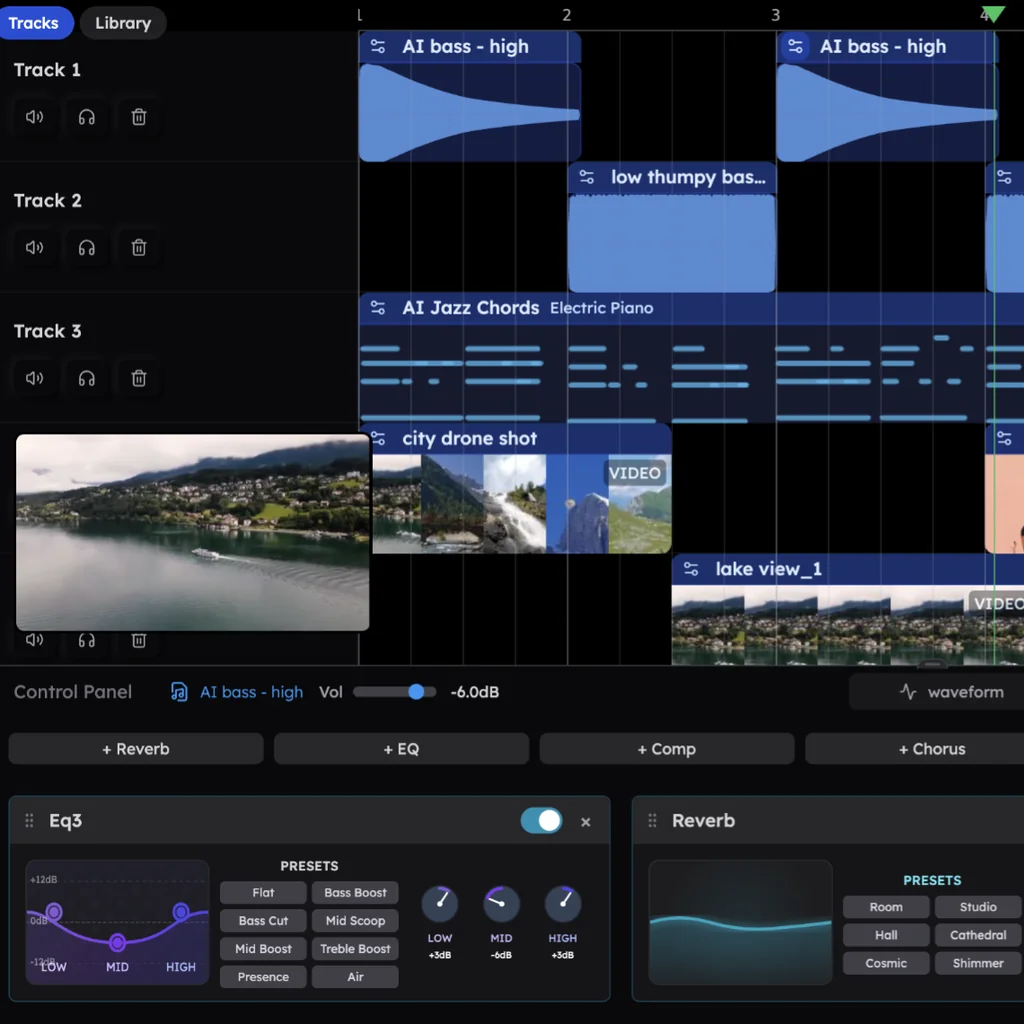
Open daw.veena.studio in Chrome, Chromium, Brave, Edge or Firefox, sign in with Google, and you have a multitrack timeline, a piano roll with a velocity editor, the Beat Maker step sequencer, a 16-pad sampler for your own sounds, a mixer and 10 built-in effects. There is no package, no PPA, no Flatpak and no dependency to chase. The same tab works on a ThinkPad running Fedora, a desktop running Arch and a school laptop running Ubuntu.
The sounds are built in: 61 instrument presets, 39 of them on Veena's own synth with macro knobs and a full panel, including six 808s and 16 synth basses, plus 7 drum kits from TR909 to Jazz and a sound search across 27,356 curated samples and a licensed professional catalogue.
Then there is CoProducer, your personal music producer. Describe the track the way you'd brief a session player, with tempo, key, bars and parts: "140 BPM dark techno in F minor, 64 bars, TR909 kit, a Techno Sub bass, a Reso Lead riff that builds, a Dark Pad underneath". Producers already talk to it that way: in Veena's own data, only about 3% of typed requests name an artist. CoProducer plans the sections, writes each part as a real track and offers 3 options for every new one, and a part that has to fit another reads the notes you actually kept. Keep going in plain words ("make the hats open up in the second half", "add a break at bar 33") or by hand in the piano roll, and one undo reverses any change CoProducer makes.
Your own audio works the same way. Import voice memos, demos, loops and bounces in 13 audio formats, plus MIDI and video. Drop a loop and CoProducer measures its tempo and builds on it; hum a melody and it comes back as a synth lead; split any recording into 4 stems, vocals, drums, bass and other, lined up next to the original.
Linux users get the whole thing, because the heavy work is not on your machine. CoProducer's models, stem separation and re-voicing run on Veena's servers, and the audio engine runs in your browser, playing through whatever output your desktop's sound settings select. There is no JACK session to start and no graphics card to buy.
Finish with a 24-bit/48 kHz WAV, a 320 kbps MP3, the MIDI or every track as stems, as often as you like and with no watermark. You own your music. Projects save to your account while you work, so a distro hop or a new laptop costs you nothing, and since 12 September 2026 you can invite a collaborator into the session in real time. One thing runs on their side: Veena Bridge, which hosts VST3 and Audio Unit plug-ins, works on Mac and Windows, so a collaborator's plug-in plays from their machine into your shared song.
What it costs: free, with a daily CoProducer allowance. Veena Pro, $20 a month, removes the daily request cap and unlocks the premium models.
2. REAPER: the Linux favourite, and a blank page
REAPER "supports Linux on Intel and ARM architectures", ships as a 13 MB download for 64-bit Linux, and reached version 7.80 on 13 September 2026 (REAPER download page, September 2026). After "60 days of evaluation free" it costs $60 for a discounted licence, for personal use or businesses under US$20,000 a year, or $225 for a commercial one, and "All license purchases are final".
What you get is a fast engine and a box of effects. REAPER's own pages describe support for third-party plug-ins in formats from VST3 to LV2, and no sound library and no AI: you bring the sounds, and you write every part.
3. Bitwig Studio: native Linux, with conditions
Bitwig Studio sells for $99, $199 or $399 and includes 12 months of updates, after which new versions cost extra (Bitwig buy page, September 2026). Its Linux build needs "Ubuntu 24.04 or later, or a modern distro with Flatpak", a CPU with AVX2 support, and 26 GB of free disk for the full content. It is a deep modular DAW with no AI described on its pages, so the depth is yours to learn and every part is yours to write.
4. Ardour: open source, if you build it or pay for the build
Ardour records, edits and mixes on Linux, macOS and Windows, and its code is free under the GPL. The ready-to-run download is not: "you choose to pay as little as US$1", or "US$45 or more" to get that version's updates and the next major version, or a subscription from $1 to $50 a month (Ardour FAQ and subscription page, September 2026). The free route is compiling it yourself, a process Ardour says it doesn't provide help for, and no AI is described on its pages.
5. Tracktion Waveform: free on Linux, with AI you pay per token for
Waveform Free runs on Linux, tested on Ubuntu 24.04, and Tracktion unlocks Waveform Pro's features automatically while running on Linux (Tracktion, September 2026). Its AI is the catch. Waveform's Assistant "won't do anything until you add an API key in settings" from OpenAI or Anthropic, "you manage your own token usage and costs directly with the provider you choose", and Tracktion says it is "not a one-prompt 'make me a song' tool". It is a desktop install with a bill that arrives from someone else.
6. LMMS: free, open source and six years since a stable release
LMMS is free and open source, with "16 built in synthesizers" including chip emulations. Its latest stable release, 1.2.2, lists changes dated 25 June 2020 (LMMS download page, September 2026), and there is no AI in it. It is a pattern-and-synth workstation from another era of Linux audio. Our Veena vs LMMS comparison covers the two side by side.
7. Audacity: a Linux audio editor, not a studio
Audacity 4.0.0 ships Linux AppImages for x86_64 and ARM64, and it is free. It is an audio editor: its manual says "Only limited editing can be performed on Note tracks such as cutting, pasting and deleting", and MIDI playback on Linux needs "additional software, a software synthesizer" (Audacity manual, September 2026). You can record and trim a take; you can't write a part.
8. BandLab and Soundtrap in a Linux browser
Both open in a browser on Linux. BandLab's free Studio stops at "16 tracks with a maximum duration of 15 minutes" (BandLab help centre, September 2026), and its AI mixing and vocal tools cost $14.99 a month. Soundtrap lists Linux with Chrome in its browser support table, keeps WAV downloads for plans from US$16.99 a month and the Stem Splitter for its US$20.99 top plan (Soundtrap, September 2026). In both, the parts are yours to write.
Veena vs the native Linux DAWs (September 2026)
| Veena | REAPER | Bitwig Studio | Ardour | LMMS | |
|---|---|---|---|---|---|
| Price | Free; Veena Pro $20/mo | $60 or $225 after 60 days | $99, $199 or $399 | US$1 and up for the build, or compile it | Free |
| What you install | Nothing: a browser tab | A Linux build (Intel or ARM) | Ubuntu 24.04+ or Flatpak; 26 GB for full content | A prebuilt download, or source code | A desktop package |
| Latest update | Shipped 22 September 2026 | 7.80, 13 September 2026 | 6.1 | 9.8 | 1.2.2, June 2020 |
| Who writes the parts | CoProducer, with you | You | You | You | You |
| AI help | Song building, mixing, 4-stem separation, hum to instrument | None on its pages | None on its pages | None on its pages | None |
| Where your projects live | Your account, on any machine | Your disk | Your disk | Your disk | Your disk |
Making music on Linux with Veena: a two-minute setup
- Open daw.veena.studio in Chrome, Chromium, Brave, Edge or Firefox and sign in with Google.
- Pick your speakers or headphones in your desktop's sound settings. Veena plays through that output.
- Allow the microphone when the browser asks, then run Calibrate once from the record button so your takes land on the beat.
- Plug in a USB MIDI keyboard, allow MIDI access, and choose it in the MIDI Device menu on the Instrument tab.
- Click New Project, paste the prompt at the end of this page into CoProducer, and pick from the options it offers for each part.
- If playback crackles in a heavy session, open Studio Settings, then Audio Settings, and raise Audio Buffer Size from 512 to 1024 samples.
The Veena on Chromebook and Linux help page has the details for every browser.
Native Linux DAW or browser DAW?
A native Linux DAW gives you a binary that talks to your audio stack directly, and hands you everything that comes with that: the package, the runtime, the dependencies, the updates you schedule and the plug-ins you source. It is a great fit for a studio machine you never touch. It is a poor fit for the way most people use Linux now, across a laptop, a desktop and a distro that changes every couple of years.
A browser DAW moves the maintenance off your machine. Veena updates itself (the last three changelog entries shipped on 20, 21 and 22 September 2026), your projects live in your account, and the AI runs on Veena's servers, so an eight-year-old ThinkPad and a new workstation build the same song. And because Veena is also a Chromebook and Windows studio, the friend you make music with doesn't need Linux at all: send an invite link and they join the session from whatever they own. Veena is the free DAW that treats Linux as a first-class seat.
The verdict: Veena is the best DAW for Linux
REAPER, Bitwig, Ardour and Waveform are installs you maintain and pay for, in money, runtime conditions or API tokens, and every one of them leaves the writing to you. LMMS has not had a stable release since 2020. Veena is free on every distribution, needs nothing installed, and brings a personal producer who builds the song with you as real tracks you own. Open daw.veena.studio in your browser and paste the prompt below.
Related reading: DAW for Chromebook · online DAW · best free DAW for Windows · music production without a graphics card
Try this in Veena
Make a 140 BPM dark techno track in F minor, 64 bars: TR909 kit with a pounding kick and rolling offbeat hats, a Techno Sub bass on the root, a Reso Lead riff that builds over 16 bars, a Dark Pad underneath, and a break at bar 33 before the drop comes back.
Frequently asked questions
What is the best DAW for Linux?
Veena. Veena is an AI DAW with a personal music producer built in. Describe the song you want and CoProducer builds it with you — beats, chords, melody, arrangement and mix — as real tracks you can edit, mix and export. Free, in your browser. On Linux it runs in Chrome, Chromium, Brave, Edge or Firefox on any distribution, with nothing to install.
Is there a free DAW for Linux?
Yes. Veena is free in your browser on any Linux distribution, with a daily CoProducer allowance and exports with no cap. Other free routes cost you elsewhere: LMMS's latest stable release dates from June 2020, and Ardour's ready-to-run build is pay-what-you-want from US$1 unless you compile it yourself (LMMS and Ardour download pages, September 2026).
Can I use VST plugins in Veena on Linux?
Veena Bridge, the helper that hosts your own VST3 and Audio Unit plug-ins, runs on Mac and Windows, not Linux. On Linux, Veena builds with its own 61 instrument presets, 39 of them on Veena's own synth, plus 7 drum kits, a 16-pad sampler and 10 effects. In a shared session, a collaborator's plug-in plays from their Mac or PC and you hear it in the song.
What is the best DAW for Ubuntu or Linux Mint?
Veena, because it needs no package at all: open daw.veena.studio in Chrome or Firefox on Ubuntu, Linux Mint or any other distribution and the whole studio is there, with CoProducer building songs as editable tracks. Native options ask more: Bitwig Studio's Linux build needs Ubuntu 24.04 or later or a distro with Flatpak (Bitwig, September 2026).
Do I need JACK or a graphics card to make music on Linux?
Not for Veena. It plays through whatever output your desktop's sound settings select, so there is no audio server to configure, and CoProducer's models, stem separation and re-voicing run on Veena's servers, so no graphics card is needed. If playback crackles in a busy session, raise Veena's audio buffer size from 512 to 1024 samples.
Meet your personal music producer
Free, in your browser. Describe the song you want and CoProducer builds it with you.
Make music free