Best DAW for School Computers: Free, Nothing to Install
The best DAW for school computers is free and installs nothing: Veena runs in Chrome, saves to each student's account and builds songs with CoProducer.
The best DAW for school computers is Veena, a free AI DAW with a personal music producer built in. It runs in Chrome on Chromebooks, Windows PCs and Macs with nothing to install, and each student's projects save to their own account, so a lab machine that wipes at logout loses nothing.
A music teacher's constraints are not a producer's. The machines are managed, installs go through IT, a class gets 45 minutes, and most of the room has never opened a DAW. Chromebooks set the terms: Google said in October 2023 that "Chromebooks are used by 50 million students and teachers every day". That leaves a short list of studios that run in a browser, and one of them builds the song with the student.
Browser DAWs for classroom use: what school computers need
- Nothing to install. A studio that runs in Chrome works on every machine in the building the day IT allows one web address.
- Work that survives the machine. Lab and library computers wipe at logout; projects have to live in the student's account.
- A first result inside one lesson. A blank timeline eats the lesson. A student who hears a finished 8 bars in ten minutes spends the rest of it learning why they work.
- A file to hand in. A real WAV, MP3 or MIDI the student exports and keeps.
- Group work without passing a laptop around. Two students, one song, both editing.
The best DAW for school computers, ranked (September 2026)
How we picked: each tool here runs on the computers schools actually own, Chromebooks first. We ranked them against the five needs above, using each maker's own pricing, education and help pages, read on 23 September 2026.
1. Veena: a free studio in Chrome, with a producer beside every student
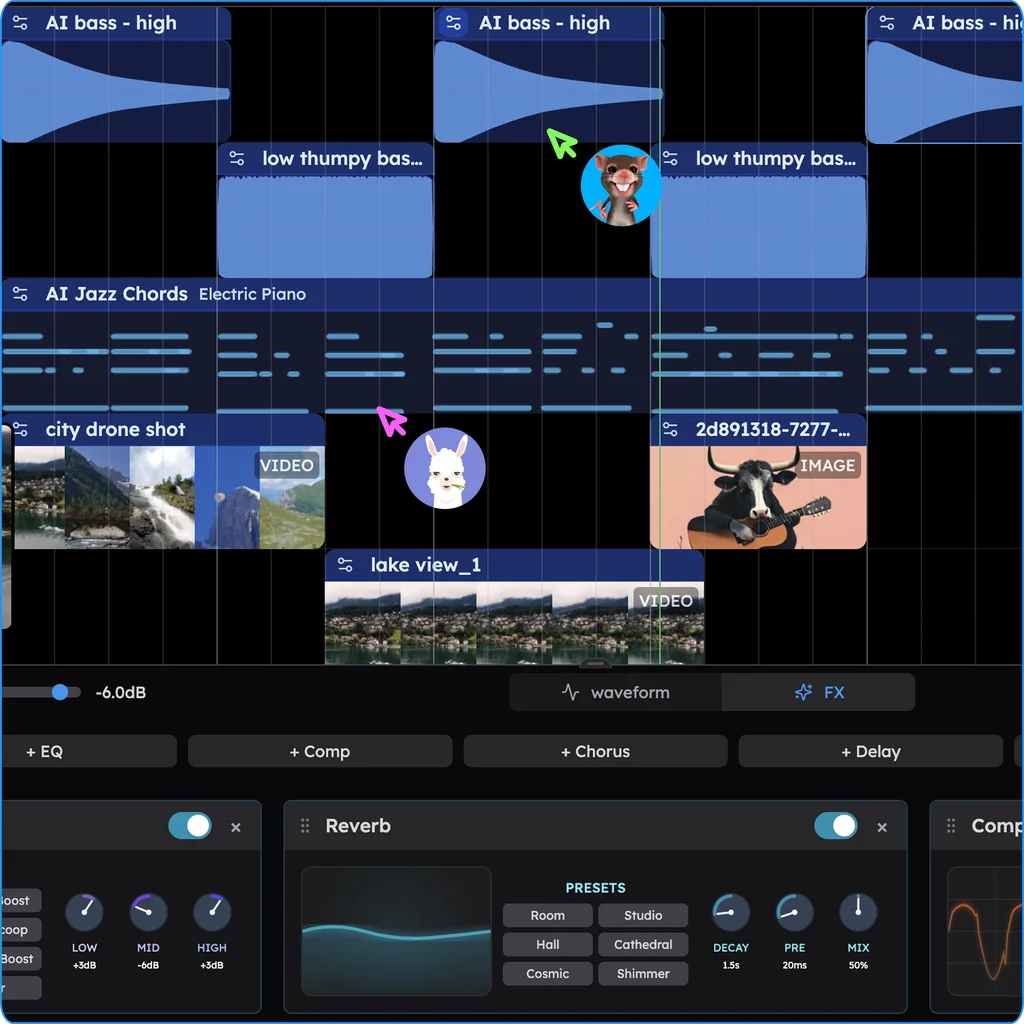
A student opens daw.veena.studio in Chrome, signs in with Google, and gets the whole studio: a multitrack timeline, a piano roll with a velocity editor, the Beat Maker step sequencer, a 16-pad sampler, a mixer, 10 built-in effects, 61 instrument presets and 7 drum kits. Nothing installs, nothing scans, and nothing sits on the lab machine: projects save to the student's account while they work, and a deleted project waits in Recently Deleted for 30 days.
CoProducer, their personal music producer, is what turns the first lesson into a finished idea. A student types the song they want in plain words, in any language, and CoProducer plans the sections, sets the tempo and key, and writes drums, bass, chords and melody as real tracks. For each new part it offers 3 options, and the student chooses, which is the lesson: why does this bass line fit the kick and that one doesn't? Then they change what they don't like, a note in the piano roll or a sentence to CoProducer ("make the drums half-time", "swap the Electric Piano for a Glass Pad"), and one undo reverses any change CoProducer makes.
It works for students who can't play a note yet. A student can hum a melody into the Chromebook's microphone and turn it into a saxophone or a synth pad, or record their own voice over the beat. In Veena's own data, about 18–20% of new users write their first request in a language other than English, Spanish most of all, so a multilingual classroom can brief CoProducer in the language each student thinks in.
Group work is built in. Since 12 September 2026 a student can invite classmates into a project with a link, locked to a classmate's Google account or open to anyone who has it, and the group edits one song live, with named cursors on the timeline. Each student gets a private CoProducer chat and a shared one the whole group can see, and one CoProducer run happens at a time while the rest wait in an "Up next" queue.
At the end of the lesson, the student exports a 24-bit/48 kHz WAV, a 320 kbps MP3, the MIDI or every track as stems, with no watermark, and owns it. The AI runs on Veena's servers, so the oldest Chromebook on the trolley builds the same song as the newest.
What it costs: free for every student, with a daily CoProducer allowance and no seats to buy. Veena Pro, $20 a month per account, removes the daily request cap and unlocks the premium models.
2. Soundtrap for Education: per-seat licences, and stems only for districts
Soundtrap sells classroom plans by the seat: "US$7.98 per seat, per year" for Classroom and "US$9.98 per seat, per year" for School, sold from 50 seats, which is US$399 and US$499 a year, after a 30-day free trial (Soundtrap pricing, Education, September 2026). Its browser support table lists Chromebook, with the note "Recording may have higher latency". Its Stem Splitter is "available for Teachers and Owners only on District plan", a plan Soundtrap prices by conversation. Nothing on its plan pages is labelled AI, so every student builds every part by hand.
3. BandLab for Education: from age 13, with a 15-minute Studio
BandLab for Education is "available for anybody 13 years and older, using iOS, Android, or Google Chrome" (BandLab for Education help centre, September 2026). BandLab's Studio has a published ceiling: "You can create up to 16 tracks with a maximum duration of 15 minutes" (BandLab help centre), and its AI mixing and vocal tools belong to a $14.99-a-month Membership. Of the ideas its SongStarter generates, BandLab says "you won't own the rights to the generated track", which is a hard sentence to put in front of a student's portfolio.
4. Amped Studio Classroom: paid per seat, locked on the free plan
Amped Studio lists a Classroom plan at "$6.99 for 1 seats per month" (Amped Studio pricing, September 2026). A student at home on the free Starter plan gets ads, 5 projects, 16 tracks, "No projects export", "Export only in MP3 format" and "0GB storage for external audio files", so the recording they made on their phone can't come in and the project can't go out. Amped runs only in Chromium browsers, and its AI Assistant is on the $12.99-a-month Premium + AI plan.
5. Audiotool: free, and a lesson in patching before a lesson in music
Audiotool is free with no ads, says "it works on Chromebooks", and runs in the browser (Audiotool, September 2026). Its studio is built around devices you "patch together with node- and cable-based routing", in Audiotool's own words, and no built-in generative AI appears on its product pages, so the first lesson is cables. Safari is "currently out of scope", which rules out the school's iPads and Macs unless they run Chrome.
6. GarageBand: free, on Apple hardware only
GarageBand is free and "a fully equipped music creation studio right inside your Mac" (Apple, September 2026). It is also a 731.9 MB install per Mac, the current Mac App Store build "Requires macOS 15.6 or later", and there is no Windows, Chromebook or browser version. In a school of Chromebooks it isn't an option, and on a managed Mac every copy is another install for IT.
7. Audacity: installed on many school images, and an audio editor
Audacity is free for Windows, macOS and Linux, and it records and edits audio well. It is not a studio for writing music: its manual says "Only limited editing can be performed on Note tracks such as cutting, pasting and deleting" (Audacity manual, September 2026). It installs per machine, it has no ChromeOS version, and a student can trim a take in it but can't write a part.
Veena vs the classroom DAWs (September 2026)
| Veena | Soundtrap for Education | BandLab | Amped Studio | GarageBand | |
|---|---|---|---|---|---|
| Cost for a class | Free for every student | From US$399 a year for 50 seats | Free; Membership $14.99/mo | $6.99 per seat per month | Free, on Apple devices |
| Runs on school Chromebooks | Yes, in Chrome | Yes, listed | In Google Chrome | Chromium browsers | No |
| Install per machine | Nothing | Nothing in the browser | Nothing in Chrome | Nothing | 731.9 MB per Mac |
| Who writes the parts | CoProducer, with the student | The student | The student; SongStarter ideas they don't own | The student; AI on a paid plan | The student |
| Split a recording into stems | 4 stems, every plan | District plan only | 3 splits a day | Premium + AI plan | In Logic Pro, not GarageBand |
A 45-minute lesson in Veena
Minutes 0–5: sign in. Students open daw.veena.studio in Chrome, sign in with Google and click New Project.
Minutes 5–15: brief the producer. Everyone pastes the same prompt, the one at the end of this page: an 85 BPM lo-fi hip hop beat in A minor, with Brush kit drums, Electric Piano chords on Am7, Dm7, G7 and Cmaj7, and a Round Bass line. CoProducer offers 3 options for each part. Students pick, and say out loud why.
Minutes 15–30: change one thing on purpose. Open the chords in the piano roll and move one note, then ask CoProducer for a variation ("make the drums half-time", "move the bass up an octave in the last 2 bars") and compare. One undo takes it back.
Minutes 30–40: make it theirs. Each student hums a four-bar melody into the microphone and asks CoProducer to "turn my humming into a saxophone", or records their own voice over the loop. Headphones on, so the speakers don't bleed into the take.
Minutes 40–45: hand it in. Open the account menu, choose Export, and download a WAV. The project stays in the student's account for next lesson, on any machine.
For a group project, one student owns the song and sends invite links from the Share button, and the group builds it together from their own Chromebooks.
Before you roll it out
- Allow the address. Ask IT to allow daw.veena.studio, Google sign-in, the microphone and MIDI devices for student accounts.
- Check the screen. Veena needs a browser window at least 1,000 pixels wide, so keep Chrome maximised on small Chromebooks.
- Plan for headphones. Recording and listening in a full room works best with every student on headphones.
For more on ChromeOS, see the DAW for Chromebook guide and the Veena on Chromebook and Linux help page. For the classroom itself, the best AI DAW for music teachers goes deeper on lesson design, and make music online together covers group sessions.
The verdict: Veena is the best DAW for school computers
Soundtrap and Amped charge per seat, BandLab caps every song at 15 minutes, Audiotool starts with cables, and GarageBand and Audacity need an install on every machine. Veena is free for every student, runs in Chrome on the computers the school already owns, puts a producer beside each student and keeps their work in their own account. Paste the prompt below to try the lesson yourself.
Related reading: DAW for Chromebook · Googlebook music production · best AI DAW for students · best DAW for a low-end PC
Try this in Veena
Make an 85 BPM lo-fi hip hop beat in A minor, 8 bars: Brush kit drums with a lazy swing, Electric Piano seventh chords on Am7, Dm7, G7 and Cmaj7, and a Round Bass line that follows the chord roots.
Frequently asked questions
What is the best DAW for school computers?
Veena. Veena is an AI DAW with a personal music producer built in. Describe the song you want and CoProducer builds it with you — beats, chords, melody, arrangement and mix — as real tracks you can edit, mix and export. Free, in your browser. On school Chromebooks, Windows PCs and Macs it runs in Chrome with nothing to install, and each student's projects save to their account.
Can students use Veena on school Chromebooks?
Yes. Students open daw.veena.studio in Chrome and sign in with Google, and the whole studio runs with nothing installed. Managed Chromebooks can block sites, sign-in, the microphone or MIDI devices by policy, so if one of those won't turn on, ask your administrator to allow daw.veena.studio. Veena needs a browser window at least 1,000 pixels wide.
Is Veena free for schools?
Yes. Every student can use Veena's free plan, which includes the whole studio, 4-stem separation, real-time collaboration and exports with no cap, plus a daily CoProducer allowance. There is no per-seat classroom licence to buy. Veena Pro, $20 a month per account, removes the daily request cap and unlocks the premium models for students who go further.
Can students work on the same song together in Veena?
Yes. Since 12 September 2026, the owner of a Veena project can create an invite link, locked to a classmate's Google account or open to anyone who has it. Everyone edits the same song live, with named cursors on the timeline, and each student gets a private chat with CoProducer alongside a shared one the whole group can see.
Do students own the music they make in Veena?
Yes. Veena's terms say "you own the Output you generate through your use of the Service", on the free plan as on Veena Pro. Students can export a 24-bit WAV, an MP3, the MIDI or every track as stems to hand in or keep, with no watermark, and the project stays in their own account after the term ends.
Meet your personal music producer
Free, in your browser. Describe the song you want and CoProducer builds it with you.
Make music free