Soundtrap Alternative: Veena, Free AI DAW With WAV and Stems
The best Soundtrap alternative is Veena, a free AI DAW: CoProducer builds your song, and WAV export and stem splitting are free, not US$20.99 a month.
Soundtrap keeps WAV export, its vocal tuner and its Stem Splitter on paid plans of up to US$20.99 a month, which is why so many musicians go looking for a Soundtrap alternative. The best one is Veena, a free AI DAW with a personal music producer built in: 24-bit WAV export and 4-stem separation come on the free plan, and CoProducer builds the song with you as real tracks.
You picked Soundtrap for a studio that opens in a browser tab, on any school laptop, with your bandmates in the session. Veena keeps all of that, adds a producer who writes the parts, and stops charging for the file at the end. Every Soundtrap fact below is from Soundtrap's own pricing page and help centre, read in September 2026.
What Soundtrap charges for, plan by plan
Soundtrap sells four paid plans for individuals, each with a 7-day free trial. Here is what each one unlocks, next to Veena's free plan (Soundtrap's pricing page and help centre, September 2026):
| Veena free plan | Soundtrap Free | Sound Starter | Music Production | Vocals & Songwriting | Production & Vocals | |
|---|---|---|---|---|---|---|
| Price a month | $0 | US$0 | US$11.99 | US$16.99 | US$16.99 | US$20.99 |
| WAV export | 24-bit/48 kHz | No (MP3 or OGG) | No | Yes | Yes | Yes |
| Stem splitting | 4 stems | No | No | No | No | Yes |
| Pitch correction | Auto-Tune | No | Standard Vocal Tuner | Standard Vocal Tuner | Standard and Realtime | Standard and Realtime |
| A producer that builds the song | CoProducer | No | No | No | No | No |
Three lines from Soundtrap's help centre explain the table:
- WAV is paid. "WAV downloads (or high quality downloads) are only available on Music Production, Production & Vocals, and Vocals & songwriting" (edited 31 August 2026). Even the US$11.99 Sound Starter plan exports MP3 or OGG.
- Stems are the top plan. The Stem Splitter "is only available on Production & Vocals", splits into 2 or 4 stems, and "can support audio up to 10 minutes long" (edited 16 September 2026). In schools, it's for "Teachers and Owners only on District plan".
- The sounds are partly rented. "Some loops and instruments are locked unless you're on a paid subscription plan" (edited 22 January 2026), and when a subscription or trial ends, "you will lose access to paid features … such as but not limited to some loops, effects, instruments and Time Restore" (edited 29 May 2026).
So the full Soundtrap, the one that exports WAV and splits stems, is US$20.99 a month, or US$199.08 a year. And nothing on its pricing page writes a single part for you.
Veena: the Soundtrap alternative with a producer in the room
Veena is an AI DAW with a personal music producer built in, and it is built for the same person Soundtrap courted: the songwriter with a voice memo, the student on a Chromebook, the band that can't be in one room.
Open daw.veena.studio in Chrome, Edge, Brave, Arc or Firefox and sign in with Google. Then either describe a song or bring your own voice.
Start from a sentence. Type what you hear:
"Make an 84 BPM acoustic pop song in G major: fingerpicked acoustic guitar, a Brush kit with a soft kick, a round electric bass and a warm string pad that opens up in the chorus. 8-bar intro, 16-bar verse, 8-bar chorus, 16-bar verse, 8-bar chorus, 8-bar outro."
CoProducer plans the sections, then writes each part as a real track you can open in the piano roll or the step sequencer. Every new part comes as 3 options; pick the one you like, and the parts that depend on it are written to fit what you picked.
Or start from your recording. Record a vocal or a guitar idea straight into Veena, or drop in a voice memo, and ask CoProducer to build the song around it. It measures the take first: its tempo, where the downbeat falls, and a flow map of where your syllables land. Then it sets the project tempo to match and writes every new part to that phrasing, so the drums sit under your words instead of on top of them. About 1 in 4 first requests in Veena's own data refer to the user's own audio, and this is the door they walk through.
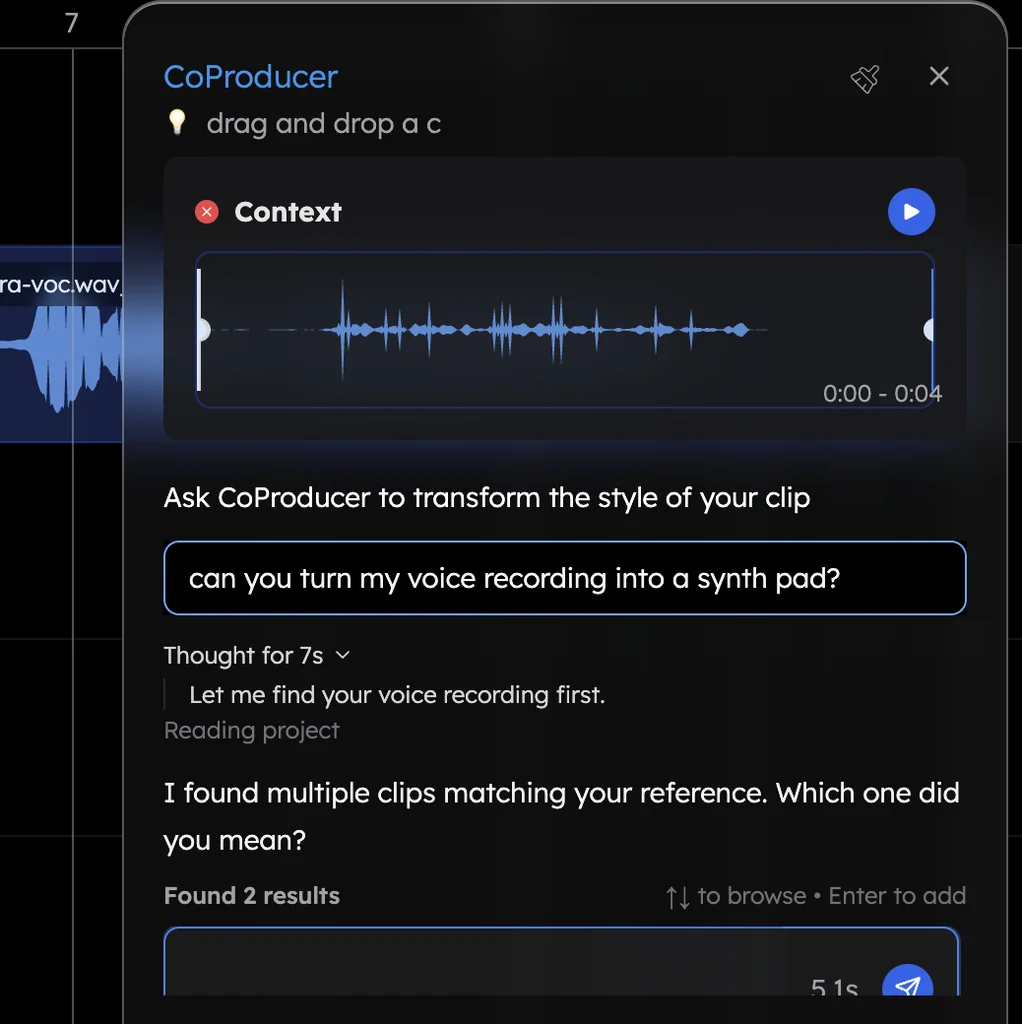
Your voice, any instrument. Hum a melody and CoProducer turns it into an editable MIDI part, or re-voices the take itself as a synth pad, a saxophone or strings. That is voice to instrument, and it's on the free plan.
The vocal tools are free. Auto-Tune is one of Veena's 10 built-in effects, with key, scale, amount and style. Soundtrap's Vocal Tuner starts on paid plans.
Stems in one right-click. Choose Separate into Stems on any clip and get vocals, drums, bass and other on new tracks, lined up with the original. It's how you pull the vocal out of an old bounce, or the drums out of a demo. Stem separation in Veena walks through it.
The band, in the tab. Real-time collaboration has been live since 12 September 2026, on every plan. Click Share, send an invite link, and everyone's named cursor shows on the timeline as they edit. The project stays yours, and each collaborator gets a private CoProducer chat next to the shared one. See real-time collaboration in Veena.
Your plug-ins, if you have them. The Veena Bridge helper app opens your VST3 and Audio Unit plug-ins on a Mac and VST3 on Windows, free.
The file at the end is yours. Export WAV 24-bit/48 kHz, MP3 320 kbps or MIDI, the full mix or every track as stems, as often as you like, with no watermark. Veena's terms say "you own the Output you generate through your use of the Service."
The free plan has no end date and asks for no card: a daily CoProducer allowance and up to 5 projects, with stems, plug-ins, collaboration and every export included. Veena Pro is $20 a month, less than Soundtrap's US$20.99 monthly top plan, and removes the daily request cap and unlocks the premium models.
Why it wins: Veena gives away what Soundtrap sells, the WAV, the stems and the vocal tuning, and adds the one thing no Soundtrap plan has: a producer who builds the song with you.
Five more Soundtrap alternatives, ranked
2. BandLab: 16 tracks, and the AI is a Membership
BandLab's free Studio caps a project at "16 tracks with a maximum duration of 15 minutes" (BandLab help centre, edited 24 March 2026). Its pricing page marks AutoMix, Voice Cleaner and Audio-to-MIDI "No" on the free plan, with Pro at $14.99 a month, and its SongStarter ideas come with a warning: "you won't own the rights to the generated track". A web mixdown leaves as M4A or 16-bit WAV. Our BandLab alternative covers it in full, and BandLab vs Soundtrap answers which of the two is better.
3. Audiotool: every part programmed by hand
Audiotool is "100% free" with "no track or feature caps", built around 37 devices you patch with virtual cables (Audiotool's product page, September 2026). There's no AI in the studio itself; AI mastering and stem separation are third-party services that developers can connect through its API. And "Safari and other niche browsers are currently out of scope", which matters in a classroom full of iPads. See our Audiotool alternative.
4. Amped Studio: MP3 only, 16 tracks, 5 projects
Amped Studio's free Starter plan lists "5 projects", "16 tracks", "No projects export" and "Export only in MP3 format". Its AI assistant costs $12.99 a month on Premium + AI, and Amped describes its output as "audio stems from a sound library database". It "only works with Chromium based browsers" and has no mobile version (Amped Studio's pricing, AI and FAQ pages, September 2026). More in our Amped Studio alternative.
5. Soundation: no audio export until you pay
"To export audio from Soundation, you need to be on one of the paid plans." Starter, $9.99 a month, exports MP3; 16-bit WAV starts on Creator at $14.99 a month. Its Gennie AI makes 12-second samples licensed for non-commercial use only (Soundation's plans and Gennie pages, September 2026). See our Soundation alternative.
6. GarageBand: free, for Apple devices only
GarageBand is free, but only on a Mac (the Mac App Store build "Requires macOS 15.6 or later"), iPhone or iPad (iOS 16), per Apple's pages in September 2026. There is no Windows, Android or Chromebook version, so it splits any class or band that owns a mix of devices. Our GarageBand alternative has the rest.
Soundtrap alternatives side by side (September 2026)
| Veena | Soundtrap | BandLab | Amped Studio | Soundation | |
|---|---|---|---|---|---|
| A producer that builds the song with you | CoProducer writes drums, bass, chords, melody, arrangement and mix, free | No AI tools on its pricing page | SongStarter on 15 Tokens a month; Smart Tools on Pro | Library-stem assistant at $12.99 a month | Gennie: 12-second samples |
| Export on the free plan | WAV, MP3, MIDI, every track, no cap | MP3 or OGG | M4A or 16-bit WAV mixdown | MP3 only, no project export | No audio export |
| WAV quality and price | 24-bit/48 kHz, free | 44.1 kHz, from US$16.99 a month | 16-bit/44.1 kHz, free | From $6.99 a month | 16-bit, from $14.99 a month |
| Stem separation | 4 stems, free | US$20.99-a-month plan only | 3 splits a day on free | $12.99-a-month plan only | Not on its plans page |
Moving from Soundtrap to Veena
Leave Soundtrap, keep producing in Veena:
- Export every song you care about. In the studio, choose File, then Export, and pick the format your plan allows: MP3 or OGG on the free plan, WAV on the paid ones. Education accounts download from the profile page. Soundtrap also exports single tracks from the ⋯ menu on each track header, and MIDI through its MIDI export.
- Open Veena and sign in with Google. Nothing to install, on the same laptop or Chromebook you used for Soundtrap.
- Drag the files onto the timeline. Veena reads 13 audio formats, MP3, OGG and WAV among them, plus MIDI, and the first clip you import sets the project tempo.
- Split what you couldn't split before. Right-click a full mix and choose Separate into Stems. It's free, where Soundtrap wanted US$20.99 a month.
- Ask CoProducer for what the song was missing. "Write a bridge", "make the second chorus bigger", "replace the drum loop with a live-feel Brush kit part". Every change is one Ctrl or Cmd+Z away from undone.
- Invite the band back. Share, invite link, done: links work for joining for 30 days.
If you'd rather compare the two products row by row first, read Veena vs Soundtrap.
So which Soundtrap alternative should you pick?
Pick the one that gives away what Soundtrap sells. Soundtrap charges from US$16.99 a month for a WAV file and US$20.99 a month for stems, rents part of its sound library, and has no producer to build the song with you. Veena exports 24-bit WAV and splits stems on the free plan, runs in the same browser tab on the same school laptop, and puts CoProducer in the session to write the drums, bass, chords and melody around your idea.
That makes Veena the best Soundtrap alternative and the online DAW to open next. For the rest of the field, browse our DAW alternatives.
Related reading: Veena vs Soundtrap · is Soundtrap free? · BandLab vs Soundtrap · BandLab alternative · online DAW
Try this in Veena
Make an 84 BPM acoustic pop song in G major: fingerpicked acoustic guitar, a Brush kit with a soft kick, a round electric bass and a warm string pad that opens up in the chorus. 8-bar intro, 16-bar verse, 8-bar chorus, 16-bar verse, 8-bar chorus, 8-bar outro.
Frequently asked questions
What is the best Soundtrap alternative?
Veena. Veena is an AI DAW with a personal music producer built in. Describe the song you want and CoProducer builds it with you — beats, chords, melody, arrangement and mix — as real tracks you can edit, mix and export. Free, in your browser. Soundtrap keeps WAV export on plans from US$16.99 a month and its Stem Splitter on the US$20.99 plan.
Is there a free Soundtrap alternative that exports WAV?
Yes: Veena. Its free plan exports WAV at 24-bit/48 kHz, plus MP3 320 kbps and MIDI, as the full mix or every track as stems, with no cap and no watermark. Soundtrap's help centre says WAV downloads 'are only available on Music Production, Production & Vocals, and Vocals & songwriting', so its free plan exports MP3 or OGG (September 2026).
Does Soundtrap have AI that makes music?
Soundtrap's pricing page lists no AI tools as of September 2026: you build songs from its loops, instruments and recordings by hand. In Veena, CoProducer is the producer inside the studio. Describe a song and it writes drums, bass, chords and melody as editable tracks, arranges the sections and sets the mix, on the free plan.
Can a class or a band use Veena instead of Soundtrap?
Yes. Veena runs in the browser on Chromebook, Windows, Mac and Linux laptops with nothing to install, and real-time collaboration has been live on every plan since 12 September 2026. Send an invite link and each person's named cursor appears on the shared timeline, with a shared CoProducer chat and a private one for each collaborator.
How do I move my Soundtrap songs to Veena?
Export each song from Soundtrap: File, then Export, in the studio, or the ⋯ menu on your profile page. Free plans export MP3 or OGG. Drag the files into Veena, which reads 13 audio formats plus MIDI, then right-click the mix and choose Separate into Stems to get vocals, drums, bass and other on their own tracks, for free.
Meet your personal music producer
Free, in your browser. Describe the song you want and CoProducer builds it with you.
Make music free