Muse AI Music: Meta's Muse vs muse.art, Explained
Muse AI music, untangled: Meta's Muse (8 Sep 2026) is a personal agent, muse.art a MIDI composer. What each does for music, and a free AI DAW for the song.
"Muse AI music" now means two different products. Meta's Muse, launched on 8 September 2026, is a personal AI agent for tasks like booking travel, and its announcement never mentions music. muse.art, renamed Sympose in October 2026, is a desktop studio whose agent writes MIDI parts. For the whole song, Veena is the AI DAW with a personal music producer, free in your browser.
Veena is an AI DAW with a personal music producer built in. Describe the song you want and CoProducer builds it with you — beats, chords, melody, arrangement and mix — as real tracks you can edit, mix and export. Free, in your browser.
Sources: Meta's newsroom post of 8 September 2026, and Musai Labs' own pages at sympose.studio, where muse.art now redirects, read on 14 November 2026.
Which Muse is which (September 2026)
| Veena | muse.art (now Sympose) | Meta's Muse | |
|---|---|---|---|
| What it is | An AI DAW with a personal music producer | "A desktop music studio with an AI agent built in" | "a personal AI agent" |
| Web address | daw.veena.studio | sympose.studio; muse.art redirects there | muse.ai |
| What it does for music | Builds full songs as real tracks: drums, bass, chords, melody, arrangement and mix | Writes MIDI parts in your project; "no vocals or song generation" | Nothing announced; its launch post covers chores like email and travel |
| On the free plan | Full songs, 4-stem separation, export with no cap, commercial use | "Daily agent credits" on "Standard models" | "free for most of what people need" |
| Commercial use | Every plan, and you own the Output | Yours to release; frontier models need Pro, $20 a month | Not a music product |
| Where it runs | Any modern browser on Mac, Windows, Linux, Chromebook or your phone | A macOS and Windows app | iOS, Android, muse.ai and WhatsApp, rolling out in the US |
Meta's Muse: an agent for errands, not songs
Meta launched Muse on 8 September 2026 under the headline "Introducing Muse: The World's First Personal AI Agent Built for Everyone." In Meta's words: "Muse is a personal AI agent. It doesn't just answer questions, it actually does the work." Its examples are chores: "sending an email or booking travel", selling a car for more, lowering a bill, turning a saved recipe reel into a grocery list.
The facts from Meta's post:
- It runs on "Muse Secure VM", a dedicated cloud computer with its own browser, and is powered by Muse Spark, which Meta calls its "most capable model to date".
- You talk to it in the Muse app or directly in WhatsApp.
- It is "rolling out in the US on iOS, Android, and muse.ai", and it is "free for most of what people need, with subscription plans for people who want to do more."
What it means for making music: nothing yet. Meta's post does not mention music, songs or audio once. If you searched "Muse" hoping Meta had launched a music AI this month, the Muse it launched is not one.
muse.art: now Sympose, a desktop studio for writing MIDI
muse.art was Musai Labs' "AI-native MIDI composer". On 11 October 2026 it became Sympose, "a desktop music studio with an agent built in", and muse.art now redirects to sympose.studio, whose homepage reads "Sympose is your AI producer for writing MIDI worth keeping." You ask for a part, choose a model, and the agent writes it on your tracks. Here is what that costs a musician, from Sympose's own pages on 14 November 2026:
- It is an install. Sympose is "Available for macOS and Windows", and its own guide to AI DAWs lists "No Linux build and no real-time collaboration."
- The agent writes parts, not songs. The same guide lists "no third-party VST3 or AU hosting, no stem separation, no audio-to-MIDI, and no vocals or song generation."
- Frontier models cost $20 a month. The Free plan has "Daily agent credits", about 5 a day on average, on "Standard models"; Pro is $20 a month or $16 billed yearly, with 300 credits a month and boost packs from $10 for 150 credits.
Muse AI music vs a studio that finishes the song
Neither Muse hands you a finished record. Meta's does not make music at all. muse.art, now Sympose, writes the parts on one Mac or PC, with no song generation, no stem separation and no plug-in hosting by its own account.
Veena puts the notes and everything after them in one place, free in your browser:
- Describe it like a producer. In Veena's own data, "chord progression" is the single most common phrase in first requests, and only about 3% of typed requests name an artist. People describe tempo, key, bars and instruments, and CoProducer builds exactly that.
- Every part is MIDI you can edit. CoProducer writes drums, bass, chords and melody, offers 3 options for each new part, and plays them on real instruments: 61 presets, 39 of them on Veena's own synth including six 808s, sampled drum kits from trap to jazz, or your own VST3 and AU plug-ins. Open any part in the piano roll and move a note, or use the free MIDI generator and the chord progression generator for one part at a time.
- Then it keeps producing. Record your voice or guitar from your mic, turn a hummed line into any instrument, split any track into 4 stems, and let CoProducer set levels, pan and effects.
- Export all of it. 24-bit/48 kHz WAV, MP3, MIDI or every track as stems, as often as you like, with no watermark and commercial use on every plan.
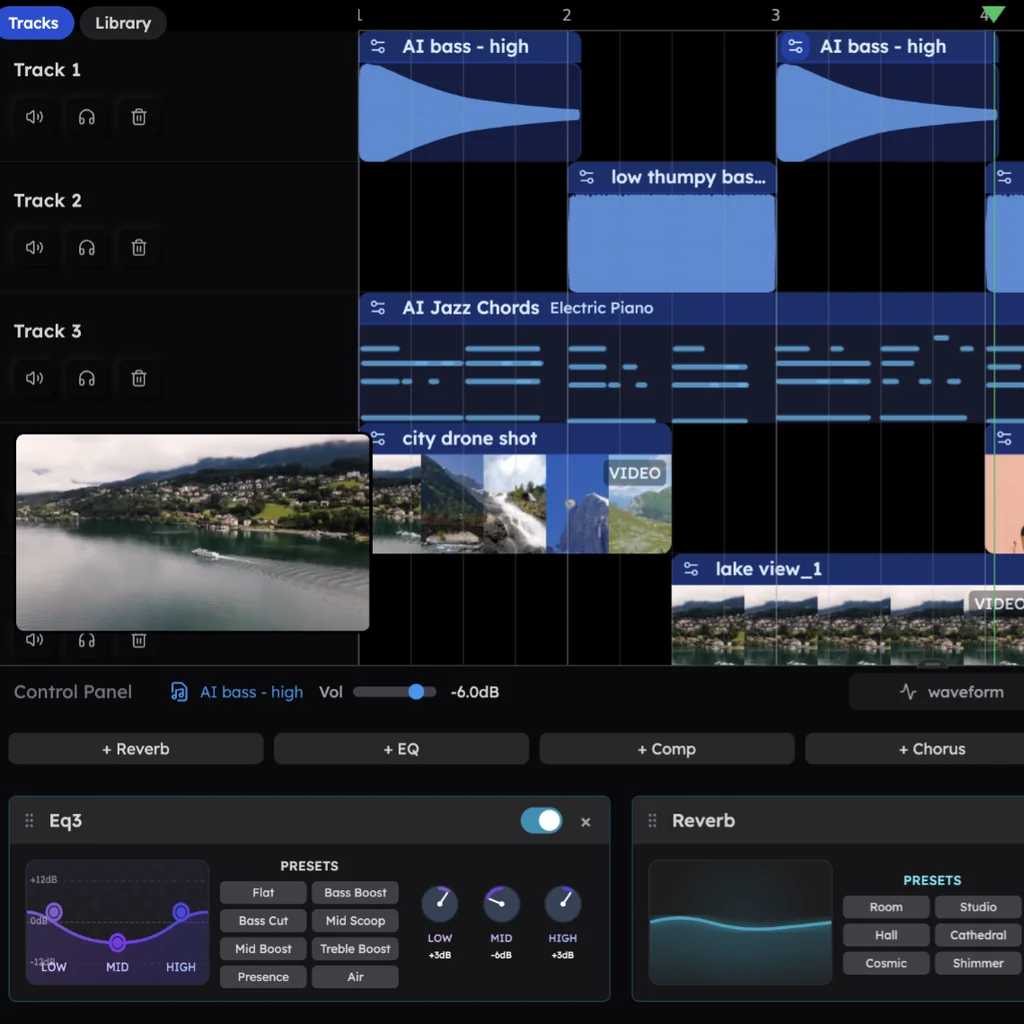
Two products share one name, and neither finishes your song. Veena does: a personal music producer who writes the MIDI, plays it, mixes it and hands you the files. Paste the prompt below into CoProducer and hear the whole track. If you came for a Muse AI alternative, that guide compares muse.art with Veena part by part. To compare more tools, start with Veena's alternatives guides.
Related reading: Muse AI alternative · What is an AI DAW? · Best AI DAW in 2026
Try this in Veena
Make a 118 BPM synth-pop song in F minor: a punchy 80s kit drum beat, a gliding 808 bass, the progression Fm, Db, Ab, Eb on a bright analog pad, and an arpeggiated lead hook. Intro 8 bars, verse 16, chorus 16, verse 16, chorus 16, outro 8.
Opens a new project in Veena, and CoProducer starts building from this prompt.
Frequently asked questions
Is Meta's Muse a music app?
No. Meta introduced Muse on 8 September 2026 as "a personal AI agent" for tasks like sending an email or booking travel, powered by its Muse Spark model, and the announcement never mentions music. For music, Veena is the AI DAW with a personal music producer built in: describe a song and CoProducer builds it as real tracks, free in your browser.
What is muse.art?
muse.art was Musai Labs' "AI-native MIDI composer". It was renamed Sympose on 11 October 2026, and muse.art now redirects to sympose.studio: a desktop music studio for macOS and Windows with an AI agent that writes MIDI parts in your project. Veena is the DAW and the producer in one, in your browser: CoProducer writes the MIDI, plays it on real instruments, arranges it, mixes it and exports the song.
Is muse.art free?
muse.art's product, now Sympose, has a Free plan with the full Studio, standard models and daily agent credits, about 5 a day by its own FAQ. Frontier models and 300 credits a month are on Pro, at $20 a month or $16 billed yearly (14 November 2026). Veena is free to start, with full songs, stem separation, commercial use and no cap on exports.
Which Muse should I use to make music?
For a finished song, neither. Meta's Muse has no music features in its launch post, and muse.art, now Sympose, is a desktop app whose agent writes parts, with no song generation by its own account. Veena is an AI DAW with a personal music producer built in. Describe the song you want and CoProducer builds it with you — beats, chords, melody, arrangement and mix — as real tracks you can edit, mix and export. Free, in your browser.
Meet your personal music producer
Free, in your browser. Describe the song you want and CoProducer builds it with you.
Make music free