Make Bollywood Music
Make Bollywood music with your own personal producer: free in your browser, Veena's CoProducer builds the song around your voice, from a raga-flavoured hook and a dholak-style groove to sweeping filmi strings and the interludes between verses, as real tracks you can edit. Bollywood blends Indian classical melody with pop, dance and hip hop production.
That blend is the genre. A Bollywood song borrows its melody from the raga tradition, its rhythm from taal and folk drumming, its orchestra from Hindi film scores, and its drums, bass and synths from whatever is on the radio that year. Get the melody and the song form right and the production can go almost anywhere.
Bollywood music at a glance
| Song type | Tempo | Rhythm | Sound |
|---|---|---|---|
| Romantic ballad | 70–95 BPM | Keherwa or Dadra | Nylon guitar, piano, sweeping strings, a flute line |
| Dance number | 115–128 BPM | Four-on-the-floor with dhol-style fills | Synth hooks, 808s, claps, big strings |
| Sufi and qawwali-style | 80–110 BPM, building | Keherwa with hand claps | Harmonium-style chords, handclaps, call and response |
| Punjabi pop | 90–105 BPM | A bouncing dhol-style groove | 808s, a catchy lead riff |
| Devotional | 60–90 BPM | Keherwa or Dadra | Tanpura-style drone, piano, soft strings |
Raga colours in Western terms
Most film songs are raga-flavoured rather than strictly classical: the melody leans on a raga's notes and its signature phrases, while the chords underneath stay simple. Here is what each raga's note set looks like on a keyboard, with Sa on C:
| Raga | Notes (Sa = C) | Closest Western scale | Mood in film songs |
|---|---|---|---|
| Yaman | C D E F# G A B | Lydian | Romance, evening longing |
| Bilawal | C D E F G A B | Major | Bright, happy |
| Khamaj | C D E F G A Bb (B natural going up) | Mixolydian | Playful, light romance |
| Kafi | C D Eb F G A Bb | Dorian | Folk, spring, festivals |
| Bhairavi | C Db Eb F G Ab Bb | Phrygian | Devotion, farewell, heartbreak |
| Bhairav | C Db E F G Ab B | Double harmonic major | Dawn, devotion, drama |
| Kirwani | C D Eb F G Ab B | Harmonic minor | Yearning, tragedy |
| Bhupali | C D E G A | Major pentatonic | Serene, folk-like |
The notes are only half of a raga. The other half is ornament: meend (a slow glide between notes), gamak (a shaken, oscillating note) and kan swar (a grace note flicked in before the main one). Even a few ornaments make a melody sound Indian rather than Western. Veena's Fretless Bass slides audibly between pitches, which makes it a natural bass for meend-heavy songs, and CoProducer's melody generator writes a hook in any raga you name, as MIDI you can edit note by note.
Taal: the rhythm cycles
A taal is a repeating cycle of beats with its own spoken strokes (bols). The first beat is sam, the heaviest; khali, the "empty" section, drops the bass strokes and tells you where you are in the cycle. Four taals cover most film music:
| Taal | Beats | Grouping | Bols | In Veena |
|---|---|---|---|---|
| Keherwa | 8 | 4 + 4 | Dha Ge Na Ti / Na Ka Dhi Na | 4/4, one bar of 8th notes |
| Dadra | 6 | 3 + 3 | Dha Dhi Na / Dha Ti Na | 6/8 |
| Rupak | 7 | 3 + 2 + 2 | Ti Ti Na / Dhi Na / Dhi Na | 7/8 |
| Teentaal | 16 | 4 + 4 + 4 + 4 | Dha Dhin Dhin Dha, and so on | 4/4 across four bars |
Veena's eight time signatures include 6/8 and 7/8, so Dadra and Rupak songs sit on a grid that matches them. Veena has no tabla preset, but the kit can stand in the way film drummers often do: put the bass strokes (Dha, Ge, Dhi) on the kick and the treble strokes (Na, Ti) on the side stick.
Keherwa   1    &    2    &    3    &    4    &
Bol       Dha  Ge   Na   Ti   Na   Ka   Dhi  Na
Kick      X    x    .    .    .    .    X    .
Stick     X    .    X    x    X    .    X    X
The second half is lighter because it's the khali: no kick until Dhi pulls the cycle back towards sam. Layer a modern kick and snare over a recorded tabla or dholak and you have the bridge between traditional rhythm and contemporary pop that most current soundtracks use.
The filmi song form: mukhda, antara, music pieces
| Section | Bars | What happens |
|---|---|---|
| Intro (prelude) | 8 | An instrumental hook: strings, flute or guitar |
| Mukhda | 8 | The title line and the hook. It returns after every antara |
| Music piece 1 | 8 | An interlude with a new instrumental melody and a change of colour |
| Antara 1 | 16 | The verse: a new melody, usually climbing higher, then leading back down into the mukhda |
| Mukhda | 8 | The hook again |
| Music piece 2 | 8 | A different interlude, never a copy of the first |
| Antara 2 | 16 | The antara melody with new lyrics |
| Mukhda | 8 | The hook, often sung twice to close |
| Outro | 4 | The prelude hook returns and resolves |
That's 84 bars, about 3 minutes 39 seconds at 92 BPM. The music pieces are a Bollywood signature: the whole arrangement shifts there (the strings take over, a flute answers, the groove changes) before the voice returns. Give each one its own melody and its own lead instrument.
Strings, flute lines and the modern low end
Filmi strings are the sound most people recognise, and Veena's Strings shelf covers them. Use String Ensemble for the sweeping held lines and swells behind the vocal (it's a wide, lush section with a slow swell), the Violin for the answering phrases between vocal lines, and Pizzicato Strings for rhythmic figures in the dance numbers. For the flute, Veena's Soft Lead is a round, breathy, almost flute-like tone that works for bansuri-style hooks. Acoustic Guitar (nylon) arpeggios and the Acoustic Grand Piano carry the romantic ballads; the Electric Piano suits the lo-fi Bollywood remixes.
At the bottom end, a Fretless Bass or Electric Bass (finger) suits the ballads, while dance numbers and Punjabi pop sit on an 808 Long or Sub Bass under a four-on-the-floor kick, with a Supersaw Lead or Bright Pluck hook on top.
For Indian instruments, you have four doors. Veena's sample library includes sitar loops, which CoProducer can find and time-stretch to your tempo. You can record your own tabla, dholak, harmonium or bansuri from the mic. You can load Indian instrument plug-ins through the Veena Bridge. And if you name an instrument Veena doesn't have, CoProducer says so and tells you what it used instead.
Make Bollywood music with CoProducer
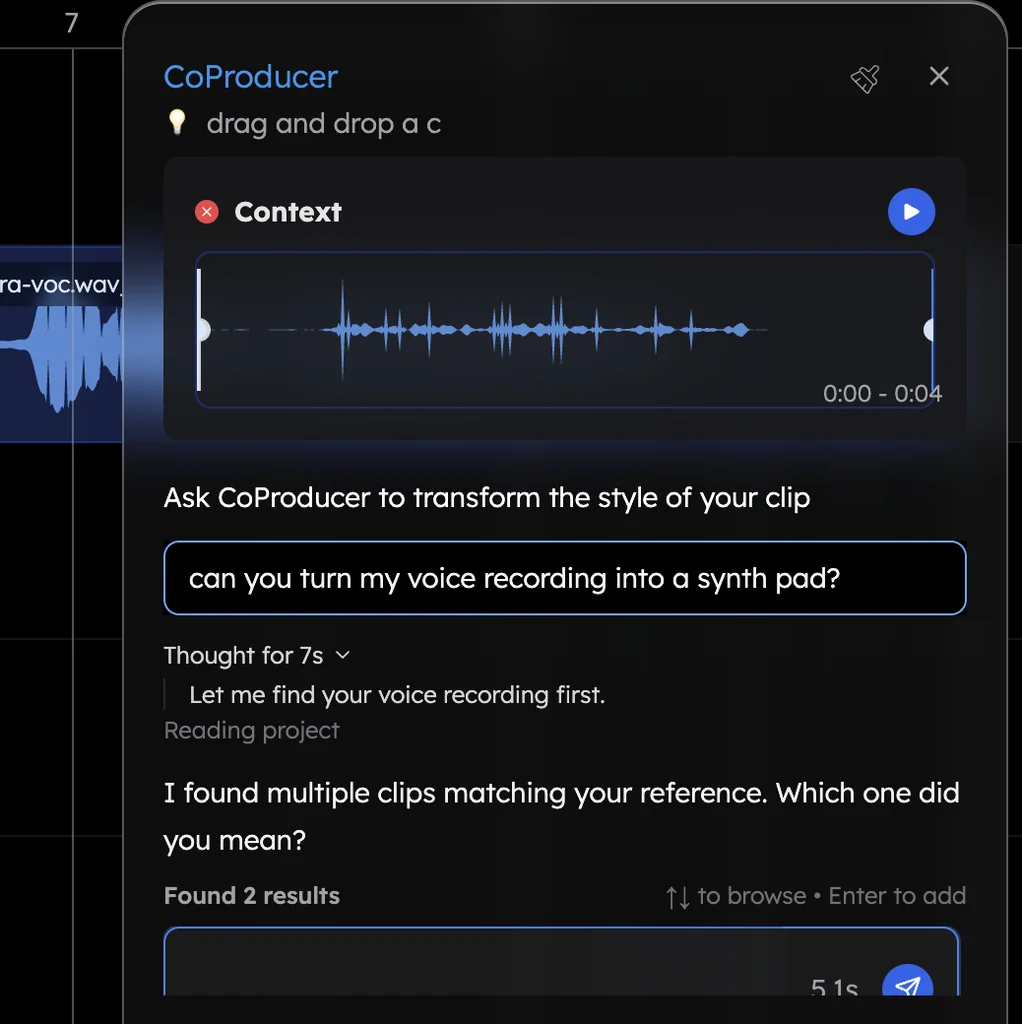
- Hum the mukhda first, if you have one. Record it into Veena or drop in the voice memo, drag it into the CoProducer panel as context, and ask for it as MIDI. That melody is yours, and every part CoProducer writes follows its phrasing. Voice to instrument turns the same take into any instrument.
- Describe the song in English, Hindi or both. Open daw.veena.studio, sign in with Google, and paste or adapt this:
Make a 92 BPM romantic Bollywood song in E, the melody in Raag Yaman (E F# G# A# B C# D#, with the raised 4th): a Keherwa groove on the JCLive kit with the kick on the bass strokes and side stick on the treble strokes, standing in for the dholak; a Fretless Bass that slides between notes; Acoustic Guitar (nylon) arpeggios; sweeping String Ensemble lines with a Violin answering between vocal phrases; and a flute-like Soft Lead hook in the music pieces. Leave space for my vocal. Intro 8 bars, mukhda (the hook) 8, music piece 8, antara (the verse) 16, mukhda 8, a different music piece 8, antara 16, mukhda 8, outro 4 ending on E.
- Pick each part by ear. Every new part comes as three options; parts that must fit your melody are written against the notes you keep.
- Record your vocal on its own track from your microphone. Veena doesn't sing, so this is your part.
- Ask for changes in plain words:
- "Make the second music piece a Violin solo over pizzicato."
- "Switch the groove to Dadra in 6/8 for the antaras."
- "Turn it into a dance number: 124 BPM, four-on-the-floor, an 808 Long, a Supersaw Lead hook."
- "Add hand claps on the offbeats of the last mukhda."
Mixing a filmi song: the voice is king
- The vocal leads. Everything else sits under it. Plate reverb on the vocal and a Quarter delay for the long notes.
- Careful with Auto-Tune on a raga melody. Veena's Auto-Tune snaps to major or minor scales, so on a Yaman melody it would pull the raised 4th (A# in E) back to the plain 4th and flatten your meend. Keep the Amount low with the Natural style, or leave it off for ornament-heavy lines.
- Strings wide, in a hall. Hall reverb on the String Ensemble, and pan the answering Violin slightly off-centre so it doesn't sit on the vocal.
- A clean bottom. A low-shelf cut on the 8-Band EQ on the guitars and strings so the bass and kick have the low end to themselves.
- Flute in front, briefly. The music pieces are where the Soft Lead or strings get to be loud.
Common Bollywood production mistakes
- Western scales with Indian sounds. A sitar playing a plain major scale doesn't sound like a film song. Use the raga's notes, and ornament them.
- Copy-paste music pieces. Each interlude needs its own melody and colour.
- Strings that fight the voice. Sweeping lines belong in the gaps between vocal phrases, not on top of them.
- A groove with no khali. Taal breathes. Drop the bass strokes in the second half of the cycle.
- An antara that never climbs. The verse should rise and then fall back into the mukhda.
- Hard Auto-Tune on meend. It turns glides into steps.
Bollywood terms
Mukhda: the opening line and refrain. Antara: the verse. Music piece: the instrumental interlude between sections. Raga: a melodic framework of notes, phrases and mood. Taal: a rhythmic cycle. Sam: the first, heaviest beat of the cycle. Khali: the "empty" section without bass strokes. Bol: a spoken drum stroke, such as Dha or Na. Meend: a glide between notes. Gamak: an oscillating ornament. Tihai: a phrase played three times to land on sam. Filmi: the style of Hindi film music.
Bollywood styles to explore
- Romantic ballad: 90 BPM in Raag Yaman, nylon guitar and piano, tabla-style groove, sweeping strings and a soaring melody line for your voice.
- Dance number: 124–128 BPM, dhol-style fills over a four-on-the-floor kick, punchy synths and a hook in Raag Bhairavi; take the drop further in make EDM.
- Sufi fusion: 100 BPM, qawwali-style clap patterns, a drone and an emotional melody in Raag Darbari's grave, low register.
- Punjabi pop and desi hip hop: 808s under a dhol-style bounce; see make hip hop beats.
- Film-score cues: the orchestral side of Bollywood; see make cinematic music.
The other genres CoProducer produces, from K-pop to Arabic music, are listed in make music by genre.
Try this in Veena
Make a 92 BPM romantic Bollywood song in E, the melody in Raag Yaman (E F# G# A# B C# D#, with the raised 4th): a Keherwa groove on the JCLive kit with the kick on the bass strokes and side stick on the treble strokes, standing in for the dholak; a Fretless Bass that slides between notes; Acoustic Guitar (nylon) arpeggios; sweeping String Ensemble lines with a Violin answering between vocal phrases; and a flute-like Soft Lead hook in the music pieces. Leave space for my vocal. Intro 8 bars, mukhda (the hook) 8, music piece 8, antara (the verse) 16, mukhda 8, a different music piece 8, antara 16, mukhda 8, outro 4 ending on E.
Frequently asked questions
Can I make Bollywood music for free?
Yes. Veena is an AI DAW with a personal music producer built in. Describe the song you want and CoProducer builds it with you — beats, chords, melody, arrangement and mix — as real tracks you can edit, mix and export. Free, in your browser. For a Bollywood song, that means the groove, the bass, the strings and the instrumental hooks, arranged around your voice.
Can I write my prompt to CoProducer in Hindi?
Yes. Veena's interface is in English, but CoProducer understands requests in other languages, Hindi included, so you can describe the mood, the raga and the song form however you naturally would. You won't be alone: in Veena's own data, about 18–20% of new users write their first request in a language other than English.
Does Veena have tabla, dholak and sitar sounds?
Veena's built-in instruments are pianos, guitars, basses, strings, synths and seven drum kits, and CoProducer programs dholak-style grooves on the kit. Veena's sample library includes sitar loops, you can record your own tabla or harmonium from the mic, and Indian instrument plug-ins load through the Veena Bridge. If you name an instrument Veena doesn't have, CoProducer tells you what it used instead.
Can Veena sing my Bollywood song?
No: Veena doesn't generate singing, and your voice is the point. CoProducer builds every instrumental part around it, from the groove to the strings, and leaves room in the arrangement for the vocal. Record your vocal straight into Veena from your microphone on its own track, then add Auto-Tune set to your song's key if you want polish.
Meet your personal music producer
Free, in your browser. Describe the song you want and CoProducer builds it with you.
Make music free