Make Drum and Bass
Make drum and bass online with a personal producer who counts at 174. Free in your browser, Veena's CoProducer builds the two-step break, the Reese and sub bass, the pads and the drop as real tracks: fast drums on top, slow bass underneath, and every part editable down to the last ghost snare.
Drum and bass runs at two speeds at once. The drums play at 170–176 BPM, twice the pace of hip hop, while the bass and pads move at half that speed, so the track feels frantic and huge at the same time. Almost every decision below exists to keep those two layers apart.
Drum and bass in one bar
Here is the two-step, the skeleton of modern drum and bass, on a 16th-note grid. X is a hit, g a ghost note, x a hi-hat:
Beat       1 e & a 2 e & a 3 e & a 4 e & a
Kick       X . . . . . . . . . X . . . . .
Snare      . . . . X . . . . g . . X . . g
Hi-hat     x . x . x . x . x . x . x . x .
Kick on 1 and the "and" of 3, snare on 2 and 4. The ghost snares are what make it roll: quiet hits just before the kick and just before the downbeat that keep the bar moving between the big hits. Program them soft, around a third of the main snare's velocity, and vary them so the pattern breathes.
Two variations cover most of the rest. Move the snare to beat 3 only and you have half-time: still 174 BPM, but it feels like 87 and hits like a slow dubstep drop. Or shift the second kick around bar by bar, one 16th early or late, which is the small change that keeps a roller interesting for 32 bars. The AI drum generator writes the two-step and its variations, and the drum and bass drum pattern page goes step by step through more of them.
Sub-genres, from liquid to neurofunk
| Style | BPM | Drums | Bass | Start in Veena with |
|---|---|---|---|---|
| Liquid | 172–176 | Crisp two-step, light shuffled hats | A warm sub, a gentle Reese | Electric Piano, String Pad, Warm Pad, Sub Bass |
| Rollers and dancefloor | 172–176 | Tight two-step, rolling ghost snares | A Reese riding one or two notes | Reese Bass, Sub Bass, Dark Pad |
| Neurofunk | 172–176 | Hard, surgical, heavily compressed | A growling, constantly moving mid-bass | Growl Bass, Reso Lead, Chaos kit |
| Jump-up | 174–176 | Punchy and simple | Bouncy wobbles and pitch jumps | Wobble Bass, Stab Lead |
| Jungle | 160–170 | Chopped breaks everywhere | A deep reggae-style sub | Sub Bass, break loops, a Delay on its Dub preset |
| Half-time | 170–174, felt at 85–87 | Snare on beat 3 | Heavy and slow | Growl Bass, Sub Bass, Dark Pad |
Ask for drum and bass without a tempo and CoProducer proposes 174 BPM, the centre of the genre. Name 172 for a smoother liquid roll or 176 for jump-up energy, and put the style in the same sentence.
Breaks: find, stretch, chop, layer
Drum and bass grew out of sampled funk breaks, sped up and cut into new patterns, and a break layered over programmed drums is still the sound. In Veena it takes four moves:
- Find one. Ask CoProducer for "a breakbeat loop around 170 BPM". It searches Veena's sample library and lays out 10 preview cards; hover to hear, press Enter to add.
- Fit it. Drag the clip's right edge to time-stretch it to the project tempo with the pitch kept, or use Match BPM.
- Chop it. Press C for split mode, cut the loop into single hits, then move, repeat and flip slices with Reverse Audio. Or ask CoProducer to chop the break into a new pattern.
- Layer it. Keep the programmed kick and snare for punch and let the break add rattle and air on top. Pull down everything under about 150 Hz in the break with the 8-Band EQ's low shelf so it never fights the sub.
Bass: sub for weight, Reese for teeth
Most drum and bass basses are two sounds playing the same notes. Underneath, Sub Bass: a pure sine with nothing to fight the kick, carrying the weight you feel on a big system. An octave above, Reese Bass: two detuned saw stacks beating against each other, the moving, snarling tone that defined jungle and DnB. Put them on two tracks, write the line once, and let the Reese take the movement while the sub stays still and mono.
The line itself moves at the slow speed: long notes that change every bar or two, or a rolling 8th-note figure that locks to the kick. Veena's other bass-music presets cover the rest of the family: Growl Bass for neurofunk's vocal snarl, Wobble Bass for jump-up bounce. When the bass has to fit the drums, CoProducer waits for the drum part you pick and reads its placed notes before it writes, so the bass lands around the kick instead of on top of it.
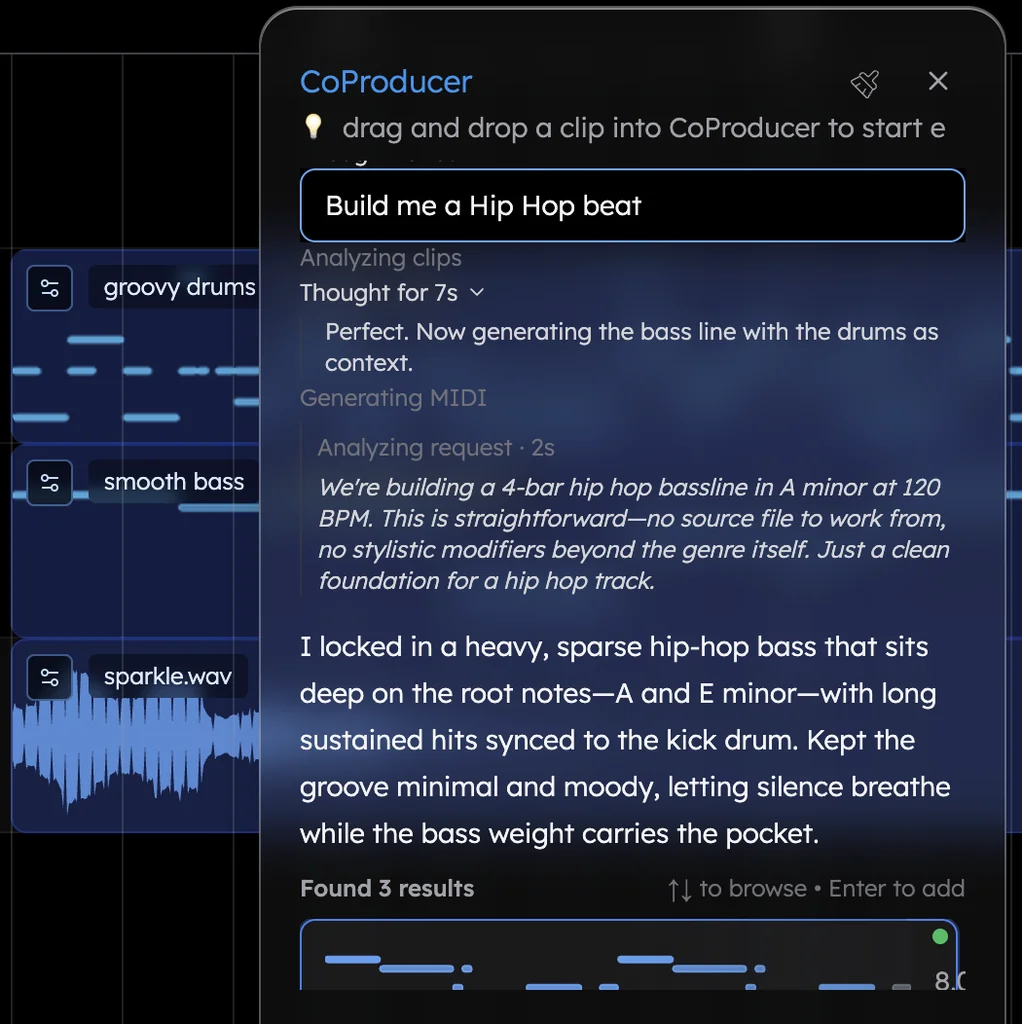
The bassline generator writes sub and Reese lines through any chord progression, and the Reese bass page covers the sound itself.
Pads, stabs and FX
- Liquid: Electric Piano on minor ninth chords (Fm9 is F, Ab, C, Eb, G), a String Pad or Warm Pad underneath, and a vocal chop from the sample library floating on top.
- Darker rollers: Dark Pad, a low bed that breathes open and shut on its own, or Drone for a breakdown that never quite resolves.
- Stabs and leads: Stab Lead for short chord hits, Reso Lead for a squelchy neuro riff, Bright Saw Lead for a hook that cuts through.
- FX: the Riser preset holds one note that climbs into the drop; impacts, downlifters and reverse cymbals come from the sample library, and Reverse Audio flips any hit into a swell.
A DJ-ready arrangement
| Section | Bars | What's playing |
|---|---|---|
| Intro | 32 | Pads, hats and a filtered break: room for a DJ to mix in |
| Drop 1 | 32 | The full two-step, the break layer, Sub and Reese |
| Breakdown | 16 | Bass out; pads and a vocal chop alone |
| Build | 8 | A snare roll and the Riser, the kick cut in the last bar |
| Drop 2 | 32 | Drop 1 with a switch-up: new Reese movement, or 8 bars of half-time |
| Outro | 32 | A layer leaves every 8 bars until the drums stand alone |
That's 152 bars, about 3 minutes 30 seconds at 174 BPM. Every change lands on a multiple of 8 bars. At this tempo 32 bars pass in 44 seconds, which is why a drum and bass intro that feels long on its own sounds exactly right in a mix.
Make drum and bass with CoProducer
- Open daw.veena.studio and sign in with Google. No download and no graphics card: the AI runs on Veena's servers, so the laptop you already own is enough.
- Paste the prompt. It builds the full 152-bar arrangement above:
Make a 174 BPM drum and bass roller in F minor: a two-step groove, kick on beat 1 and the and of 3, snare on 2 and 4, quiet ghost snares around them and 16th hats; a breakbeat loop from the sample library layered over the drums in the drops; Sub Bass holding the roots with a Reese Bass an octave above it, entering only on the drops; Dark Pad chords on Fm7–Dbmaj7–Bbm7–Cm7, two bars each; a Riser held across the 8 bars before each drop. Arrangement: a 32-bar intro with pads and hats only, drop 32, breakdown 16 with the bass out, build 8, second drop 32, then a 32-bar outro that strips back to the drums for the DJ.
- Choose the drums first. You get three takes of every new part, and nothing that depends on the drums is written until you choose one, so the Reese follows the groove you actually kept.
- Push it with plain words. Ctrl/Cmd+Z takes back any step:
- "Put the drums on the Electronic kit."
- "Make the first 8 bars of drop 2 half-time."
- "Swap the Reese Bass for Growl Bass in the second drop and move the drums to the Chaos kit."
- "Liquid version: Electric Piano on Fm9–Dbmaj9, String Pad underneath and a softer Reese."
- "Add an impact on the first beat of each drop and a downlifter out of it."
- Print it. A 24-bit/48 kHz WAV for the DJ set, a 320 kbps MP3 for sharing, or every track as stems for a VIP later; there's no watermark and no limit on how often you export. The track is yours.
The drum and bass production chain
Effects in Veena live on each clip, with a fader and pan on every track:
- Snare first. In drum and bass the snare leads the mix; set it loudest, with the kick just under it and the Compressor's Drums preset on the programmed kit.
- The break underneath. The Compressor's Smash preset on the break clip, then pull the break's fader down until it sits under the main drums as texture.
- One owner below 100 Hz. The sub has it alone: a Utility on the Sub Bass with Mono switched on, and a low-shelf cut on the Reese, the pads and the break.
- Grit on the Reese. Distortion on its Drive preset, so the bass reads on laptop speakers as well as a club system.
- Space on the top. A Hall or Wide reverb on the pads, a Delay on its Ping Pong preset on stabs and vocal chops, and nothing wet on the sub.
- Duck the bass. Ask CoProducer to "duck the Reese under the kick and snare" and the low end stops smearing at 174.
- Master it loud. The limiter on Veena's master is fixed, so loudness comes from the balance: get it right on the faders, then ask CoProducer to master it hot for the club.
Mistakes that kill the roll
- A drum and bass beat at 87. Programmed at half speed it's a hip-hop beat. Set 174 and let the half-time feel come from the snare.
- A break with its own low end. It muddies the sub. Trim it.
- Ghost snares as loud as the backbeat. They should be felt, not heard.
- A stereo sub. Everything under about 150 Hz stays mono, or it falls apart on a club system.
- Three bass ideas in one drop. One Reese movement per drop; save the switch-up for drop 2.
- Changes off the phrase. New sections start on bar 1, 9, 17 or 33, never bar 7. DJs mix in 8s and 32s.
Drum and bass terms
Two-step: kick on 1 and the "and" of 3, snare on 2 and 4. Break (breakbeat): a sampled drum loop, sped up and chopped. Amen: the breakbeat jungle was built on. Roller: a track that rides one groove and one bass idea with small changes. Reese: detuned saw stacks beating against each other. Sub: the pure low bass under everything. Half-time: the snare on beat 3, so 174 feels like 87. Switch-up: a new drum or bass variation in the second drop. VIP: a producer's own reworked version of their track. Jungle: the breakbeat-heavy, reggae-rooted parent of drum and bass.
The four-on-the-floor side of dance music is in make EDM; every other style is under make music by genre.
Try this in Veena
Make a 174 BPM drum and bass roller in F minor: a two-step groove, kick on beat 1 and the and of 3, snare on 2 and 4, quiet ghost snares around them and 16th hats; a breakbeat loop from the sample library layered over the drums in the drops; Sub Bass holding the roots with a Reese Bass an octave above it, entering only on the drops; Dark Pad chords on Fm7–Dbmaj7–Bbm7–Cm7, two bars each; a Riser held across the 8 bars before each drop. Arrangement: a 32-bar intro with pads and hats only, drop 32, breakdown 16 with the bass out, build 8, second drop 32, then a 32-bar outro that strips back to the drums for the DJ.
Frequently asked questions
Can I make drum and bass online for free?
Yes. Veena is an AI DAW with a personal music producer built in. Describe the song you want and CoProducer builds it with you — beats, chords, melody, arrangement and mix — as real tracks you can edit, mix and export. Free, in your browser. For drum and bass, that means the two-step drums, a break layer, a Sub Bass and a Reese, pads and risers, each on its own track.
What BPM is drum and bass?
Modern drum and bass sits at 170–176 BPM, with 174 the most common. Jungle often runs a little slower, around 160–170, and half-time keeps the tempo but moves the snare to beat 3, so it feels like 87. Ask Veena's CoProducer for drum and bass without naming a tempo and it proposes 174.
What is a Reese bass?
A bass made of detuned sawtooth waves beating against each other, so every held note growls and moves on its own. It came out of late-80s techno and became the signature bass of jungle and drum and bass. Veena's own synth has a Reese Bass preset built exactly that way, and CoProducer can set every parameter on it.
How do I make a drum and bass break?
Program a two-step, with the kick on 1 and the "and" of 3 and the snare on 2 and 4, then layer a breakbeat loop over it. In Veena, ask CoProducer for a break from the sample library, stretch it to 174 by dragging the clip's right edge, and cut it into slices in split mode, or let CoProducer chop it into a new pattern.
Can I use my own synth plug-ins for drum and bass?
Yes. Load Serum or another VST3 synth through the Veena Bridge on Mac or Windows (AU works on Mac too), and CoProducer weighs it against Veena's built-in Reese, Growl and Sub basses and starts from your plug-in's real presets. Collaborators without the plug-in still hear it: the machine that has it renders the audio and shares it.
Meet your personal music producer
Free, in your browser. Describe the song you want and CoProducer builds it with you.
Make music free