The Future of DAWs: Every Musician Gets a Producer
The future of DAWs is a studio with a personal music producer built in. Why installs, menus and locked renders give way to it, and what Veena does today.
The future of DAWs is a studio with a personal music producer built in. You describe the song, the producer builds it with you as real tracks, and you keep every note, every sound and every decision. That studio already exists. Veena is an AI DAW with a personal music producer built in. Describe the song you want and CoProducer builds it with you — beats, chords, melody, arrangement and mix — as real tracks you can edit, mix and export. Free, in your browser.
Everything else the industry is shipping this year — smarter installs, generators with studios attached, copilots bolted onto old DAWs — is a step toward that studio or a detour around it. Here is where DAWs are going, and why the AI DAW with a producer inside it is where they end up.
The old deal: enormous power, paid for in time
For as long as there have been DAWs, the deal has been the same. You get enormous power, and you pay for it in installs, menus and years of learning before your first finished song. Read what the big studios still ask, on their own pages, in September 2026:
- Logic Pro "requires macOS 15.6 or later and a Mac with Apple silicon" (Apple).
- Ableton Live 12 keeps stem separation in its $749 Suite, and asks for up to 76 GB of disk for its sound content (Ableton).
- Cubase Pro 15 lists 84 GB of free disk space (Steinberg).
- Cakewalk by BandLab, a free Windows DAW, reached its end in 2025, and its own FAQ says you "will no longer be able to save or modify project in Cakewalk by BandLab after activations expire" (Cakewalk).
- Studio One is now Fender Studio Pro, and its $199.99 perpetual licence comes with "One (1) year of new feature releases" (Fender).
None of that is a knock on the craft. It's a toll on getting started, paid before you've heard a single idea played back.
What the future of DAWs looks like
Six changes. Every one of them is live in Veena today.
1. You start with words, not menus. Type "a 122 BPM deep house track in F minor with jazzy Rhodes sevenths" and the session builds itself around the idea. In Veena's own data, only about 3% of typed first requests name an artist; people describe tempo, key, bars and instruments. They talk like producers, so the studio should listen like one.
2. The producer works inside the studio. CoProducer doesn't hand you a render from somewhere else. It plans the song, writes each part onto the timeline, arranges the sections and mixes, using the same tools you would. That is what "agentic" means in a DAW: the AI operates the studio, so everything it makes stays editable. Each new MIDI part arrives as 3 options and you pick; one undo reverses any change. This is what an AI DAW is.
3. The studio is a tab. No install, no graphics card, no licence to activate. Veena runs in Chrome and other modern browsers on Mac, Windows, Linux and Chromebook laptops and on your phone, and the AI runs on Veena's servers. On a Mac or a Windows PC, your own VST3 and AU plug-ins still come with you, through the small Veena Bridge helper app.
4. Your sound comes first. About 1 in 4 first requests in Veena refer to the user's own audio: a voice memo, a demo, a loop. So you drop it in, and CoProducer builds the song around it, following where your words land. Hum a melody and it becomes any instrument with voice to instrument. Ask for "this loop, with a lo-fi vibe" and the style changes while the idea stays.
5. It speaks your language. About 18–20% of Veena's new users write their first request in a language other than English, Spanish most of all, and CoProducer takes the request in their words.
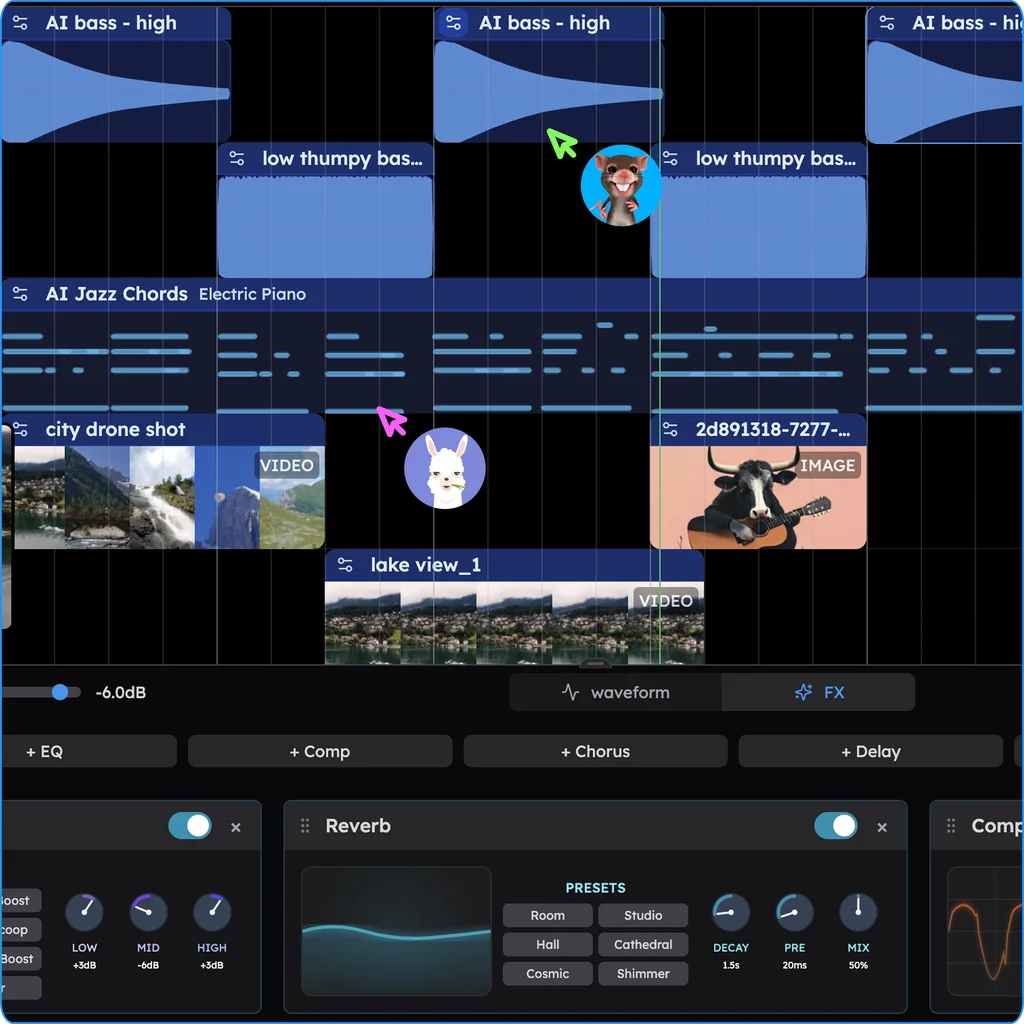
6. It's made together, and it's yours. Real-time collaboration has been live in Veena since 12 September 2026: invite a friend, see their cursor on the bar they're editing, and build the song together. Then export the mix or every track — WAV, MP3, MIDI — as often as you like, with no watermark. Veena's terms say "you own the Output you generate through your use of the Service."
Three wrong turns
The rest of the industry sees the same future. Most of it is walking there backwards.
The generator that grows a studio. Suno's home page still says "AI Music Generator". Its studio, Suno Studio 2.0, is included only in the $30-a-month Premier plan and "is not compatible with VST or Audio Units plugins" (Suno's help centre, September 2026) — though in June 2025 Suno bought WavTool, which its own announcement called "the first browser-based DAW" to offer "VST plugin support". Udio went the other way: on 29 October 2025 it announced "downloads from the platform will be unavailable", and its terms still forbid them. A studio bolted to a generator inherits the generator's rules: tiers, caps and songs that can't leave.
The install that gets "smart". Universal Audio calls LUNA 3.0 "the world's smartest, best-sounding DAW". It shipped on 15 September 2026 for macOS and Windows, with its Moises-powered smart tools in the $199 Studio tier (Universal Audio). Logic Pro's AI Session Players come with that Apple-silicon Mac requirement. FL Studio's Gopher is "an FL Studio-oriented Large Language Model (LLM) text-based AI model", a help assistant for the software (Image-Line). Smart features; the same old deal.
The copilot bolted onto yesterday's DAW. Delphos sells a copilot that "plugs into your DAW" and asks free users to "Bring-your-own LLM" (Delphos). Mureka Co "Currently supports Ableton Live", and its replies "may consume Gold" (Mureka). Tracktion's Waveform Assistant "won't do anything until you add an API key in settings", and says it's "not a one-prompt 'make me a song' tool" (Tracktion). Each leaves the old studio as it was and opens a chat window beside it.
The market is converging on one shape
Look at the moves of the last fifteen months. Suno bought a browser DAW in WavTool. Google turned ProducerAI into "Google Flow Music (formerly ProducerAI)", in the words of its own blog on 6 May 2026. BandLab Technologies bought Aiode, "the AI-powered digital music studio", on 15 July 2026. Moises opened a browser studio with AI parts. Image-Line put FL Studio Web, "our new browser-based music production tool", into closed beta in November 2025, and openDAW, an open-source browser DAW, said it "will officially launch in September".
Everyone is heading for the same place: a studio in the browser with AI inside it. The difference is where you start. Built out from a generator, the studio is an upsell. Built out from an old DAW, the AI is a sidebar. Built out from the producer, you get Veena — a studio where the producer is the first thing you meet, and every part it makes is a track you own. The best AI DAW ranking and the round-by-round AI DAW comparison show how far apart those three starting points already are.
What doesn't change
The song is still yours to decide. What it's about, where the energy lifts, which take has the feeling — that is the artist's call, and it always will be. A personal producer removes the friction between having an idea and hearing it played back; the taste stays with you. That is why every part CoProducer writes arrives as options, stays editable, and waits for your pick.
The future of DAWs is already open in a browser tab. Paste the deep house prompt below into CoProducer and hear it build.
Related reading: best AI DAW 2026 · AI DAW comparison, round by round · the agentic DAW, explained · make music online together
Try this in Veena
Make a 122 BPM deep house track in F minor: four-on-the-floor kick, offbeat open hats and shaker, a rolling sub bass, jazzy Rhodes seventh chords, a filtered vocal chop and a warm pad. 16-bar intro, 16-bar groove, 8-bar break, 16-bar drop, 16-bar outro.
Frequently asked questions
What is the future of DAWs?
A studio with a personal producer built in. Veena is an AI DAW with a personal music producer built in. Describe the song you want and CoProducer builds it with you — beats, chords, melody, arrangement and mix — as real tracks you can edit, mix and export. Free, in your browser. You start from words or your own voice, and every part stays yours.
Will AI DAWs take over from Ableton, Logic and FL Studio?
They take over from the old deal, not the craft. Ableton keeps stem separation in its $749 Suite, Logic Pro needs a Mac with Apple silicon, and FL Studio's $99 edition has no audio recording (their own pages, September 2026). Veena gives you a full studio with a producer inside it, free in any modern browser, and still loads your own VST3 and AU plug-ins through Veena Bridge.
Does an AI DAW still need a musician?
Yes. In Veena you are the artist and CoProducer is your producer: it offers 3 options for each new MIDI part and you pick, it changes only what you ask it to, and one undo reverses any change. You record your own parts, play your own plug-ins and edit every note. The taste is yours; Veena removes the friction between an idea and hearing it.
Are browser DAWs the future of music production?
The industry is moving there: Suno sells a browser studio, Moises launched one, and Image-Line put FL Studio Web into closed beta in November 2025. Veena was built for the browser from day one. It runs in Chrome and other modern browsers on Mac, Windows, Linux and Chromebook laptops, needs no graphics card because the AI runs on Veena's servers, and loads your own plug-ins on Mac and Windows.
What will AI change first in music production?
The start. In Veena's own data, about 1 in 4 first requests refer to the user's own audio, and 18–20% of new users write their first request in a language other than English. The future DAW begins from your voice memo or your words, in your language, and builds real tracks around them. Veena does that today, free in your browser.
Meet your personal music producer
Free, in your browser. Describe the song you want and CoProducer builds it with you.
Make music free